
 Tiếng Việt
 English
 中文
中文
5G on Elevator Media Screens: When DOOH Responds to the Real World
Last updated: 22 Aug 2026At 7 a.m., rain begins to fall in Hanoi. Inside the elevator of an office building, an advertising screen quietly changes its content: a ride-hailing app offers a discount code for a rain-free commute, while a tea brand alongside it suggests “a warm cup before work.”
A few dozen seconds later, in a building in Ho Chi Minh City where the sun is blazing, the same media network is displaying completely different content: an offer for a car ride and a beverage brand promoting a refreshing smoothie.
These are not two different campaigns. They are running on the same infrastructure, responding differently to the same type of signal from the real world outside: in this case, weather. But as the following examples demonstrate, weather is far from the only variable capable of triggering this kind of response.
“Weather-triggered DOOH” — Digital Out-of-Home advertising that changes content according to actual weather conditions — is no longer an experimental concept. It is already a recognized category with award-winning cases and concrete business results.
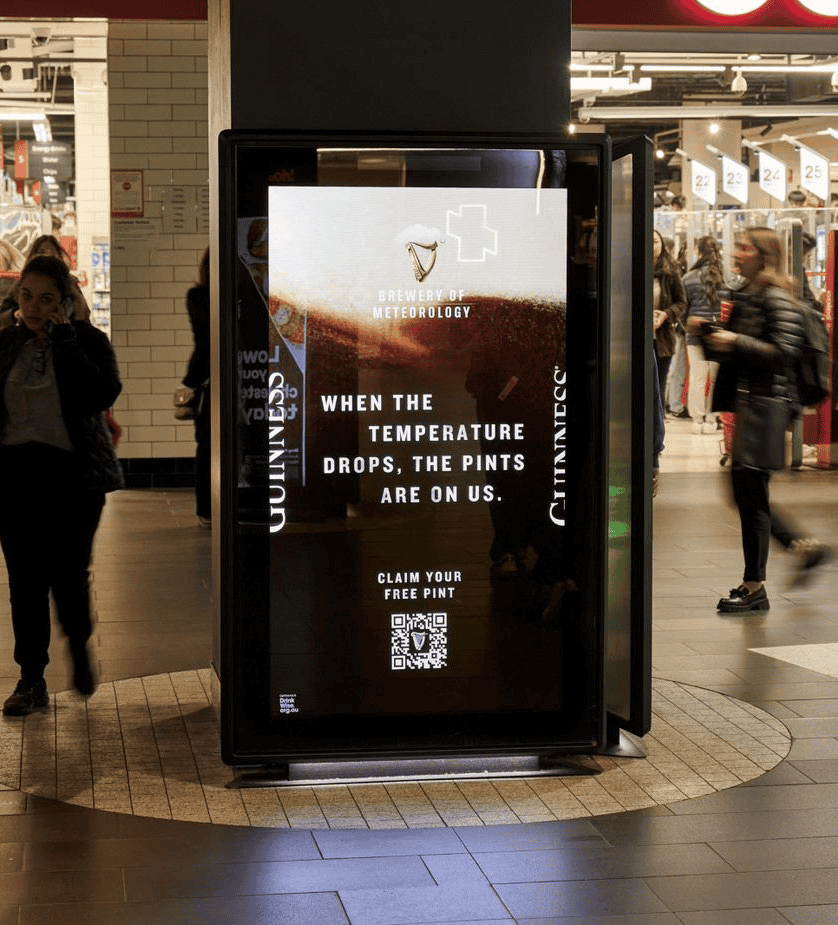
In Australia, Guinness once faced a difficult challenge: summer is peak season for light, cold beer, while a rich, dark pint is harder to associate with hot weather. The brand decided to go against the season. Its “The Guinness Brewery of Meteorology” campaign activated advertising only when temperatures fell below 7°C, using screens located within a 1 km radius of bars serving Guinness and offering consumers a free pint. The campaign won Gold at The Drum Awards for Media 2024.
In the Philippines, McDonald’s connected its McSavers offers to real-world weather conditions through DOOH: nearly 1 million impressions in just 10 days, accompanied by a 9% increase in store visits.
In Brazil, Uber ran a real-time programmatic DOOH campaign: when it rained, the content positioned Uber as a convenient transportation option; when temperatures rose, the message shifted toward the comfort of air-conditioned vehicles — one media network, two scenarios, depending on the moment.
A tea brand in India activated its “a warm cup” message only when rain began falling in each specific area and recorded a 35% higher click-through rate than static advertising.
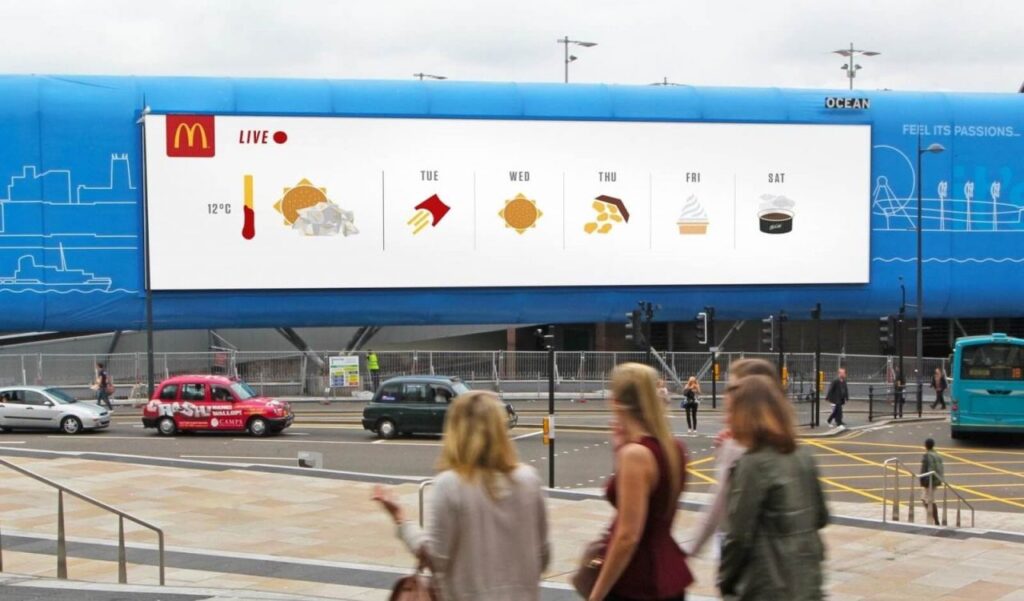
The common denominator across all these cases is simple: the content changes not because the media schedule changes, but because the world outside the screen changes.
This is the part that is often overlooked when discussing weather-triggered advertising or any form of real-time content: the decisive factor is not the creative idea itself, but the data transmission infrastructure behind it.
An idea such as “change the content when it rains” becomes meaningless if it takes hours — or even days — to update thousands of screens nationwide.
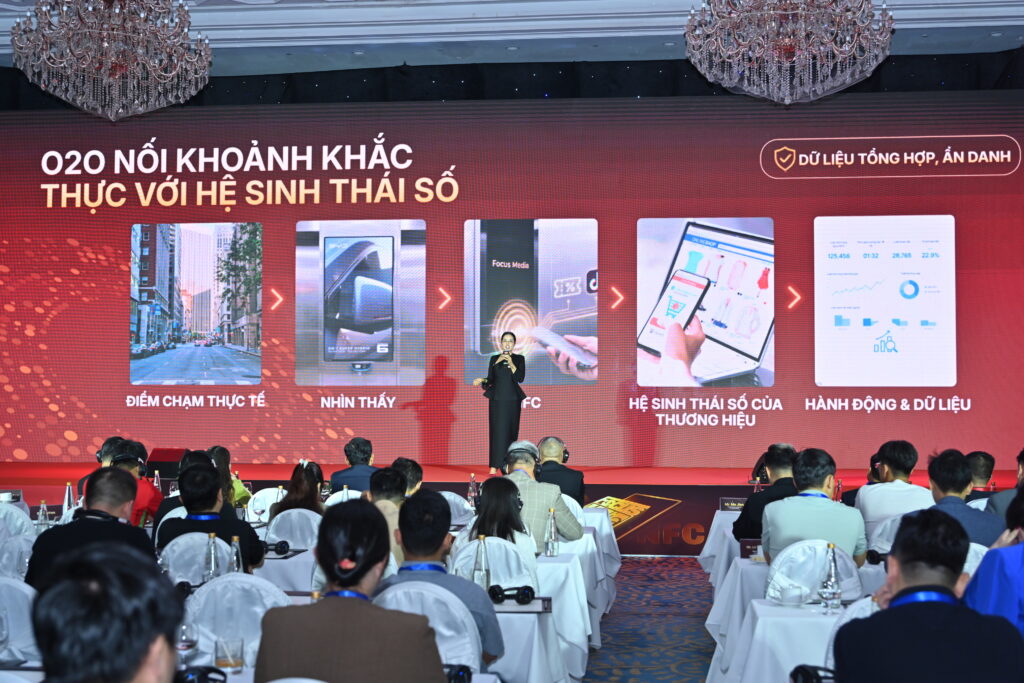
In July 2026, at “The New Era Of Elevator Media” event, Focus Media Vietnam announced the completion of its 5G data transmission infrastructure across its nationwide network of more than 18,000 Elevator Media Advertising screens.
At the same time, the Remote Data Transmission system enables centralized management and near-real-time content updates nationwide, significantly reducing deployment time compared with the previous manual operating model, where every content change required personnel to visit individual locations.
This is not merely a statement on paper.
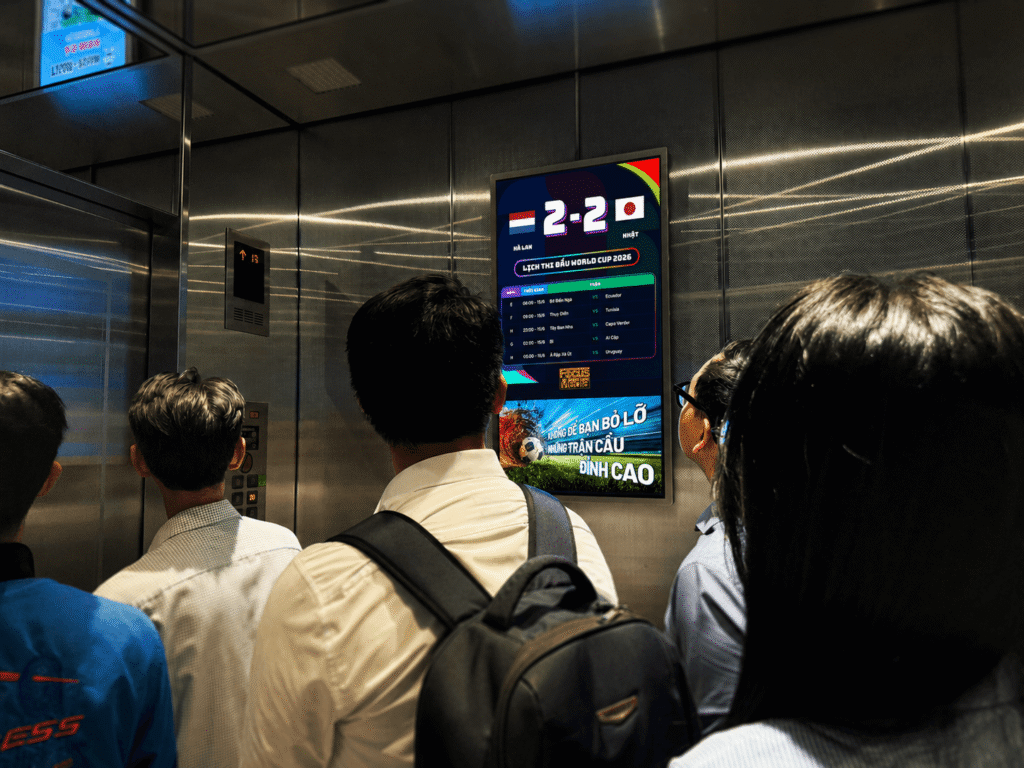
Since mid-June 2026, Focus Media Vietnam has been piloting the technology in real-world conditions by updating FIFA World Cup 2026™ scores, images, and highlight moments in real time, displayed alongside brand advertising across its entire screen network in office buildings and premium residential developments in Hanoi and Ho Chi Minh City.
Sports score updates — a content category requiring exceptionally high speed and accuracy — represent one of the most demanding tests of remote data transmission capabilities.
If the system can accomplish this across an entire network, then changing content according to a slower-moving and more predictable variable such as weather is technically within reach.
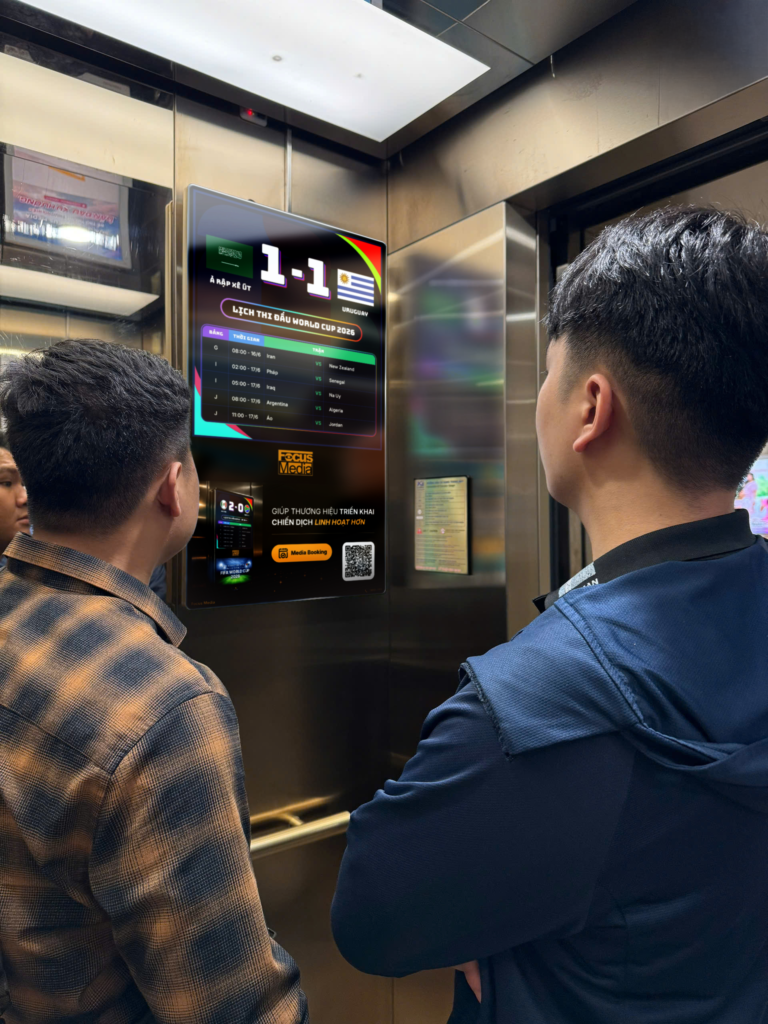
The second layer of this infrastructure is NFC, which is being deployed in phases and is expected to be completed in September 2026.
This is the component that transforms a display screen into an actionable touchpoint: viewers can tap their phones directly at the elevator to book a ride, receive a discount code, or continue their journey on the brand’s app, instead of simply seeing an advertisement and forgetting it before leaving the elevator.
A Cốc Cốc survey of nearly 900 users found that 76% use elevators every day or several times per week, while 27% of them continue searching for information online immediately after seeing an advertisement in an elevator.
The opportunity to connect the offline journey with the online journey is therefore real. What has been missing is a mechanism fast enough to capture the right moment.
With 5G enabling real-time content changes and NFC turning content into action, brands in Vietnam are no longer limited to a single scenario.
Weather is simply the most intuitive example — easy to understand and easy to communicate. The same Remote Data Transmission mechanism can respond to any variable changing in the outside world, and the international DOOH industry has already tested and measured results across many variables beyond weather.
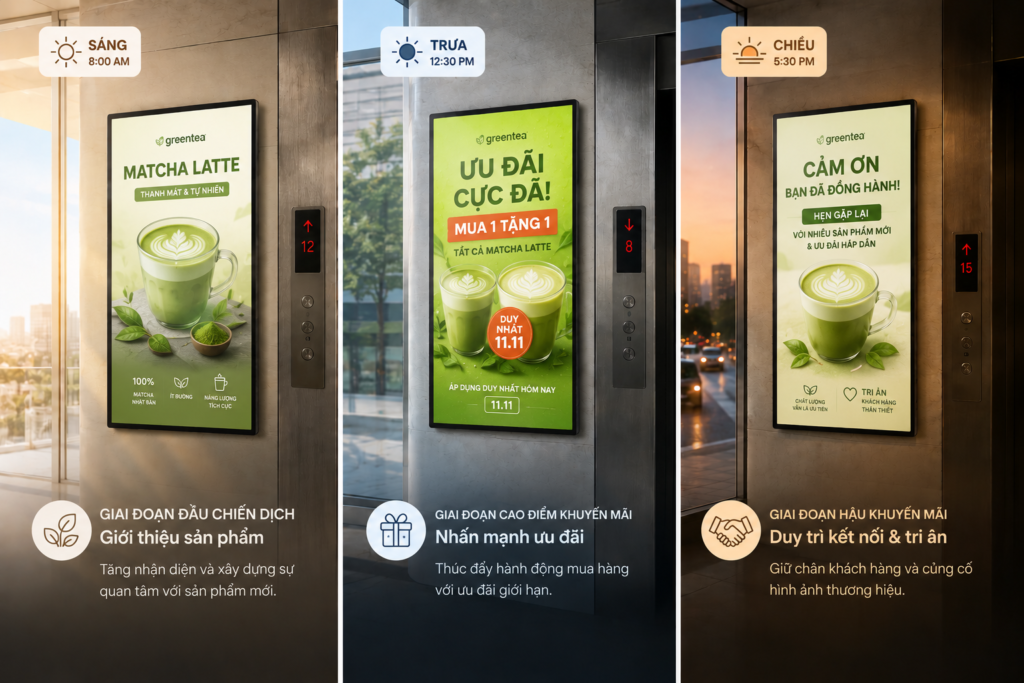
Weather. When it rains, screens can prioritize content that addresses an immediate inconvenience: a ride-hailing discount code for a dry journey home, or a cup of hot tea or coffee to “warm up before the meeting.”
When the weather is hot and sunny, the same screen placement can shift direction: an offer for an air-conditioned ride, or a refreshing juice or smoothie.
Both scenarios can end with a single NFC tap — book the ride immediately or receive a promotional code valid that day.
Live events and breaking developments. This is precisely what Focus Media Vietnam recently tested with FIFA World Cup 2026™ scores: timely content and brand messaging appearing within the same frame at the moment viewers are genuinely interested in the event.
Using the same logic, a major promotional campaign, a festive shopping season, or another sporting event can become a contextual anchor for content. Instead of running one fixed creative for an entire month regardless of what is happening outside, the content can adapt to what audiences actually care about at that moment.
Environmental indicators. The possibilities extend beyond temperature, rain, or sunshine.
Vaseline once ran a DOOH campaign in Malaysia in which skincare content automatically changed according to the actual daily UV Index, on a scale from 1 to 10. The campaign generated more than 1.65 million impressions on screens across the Klang Valley area alone.
In Vietnam, the same mechanism could potentially be applied to air-quality indicators — recommending masks or air purifiers on days when pollution levels rise, rather than displaying the same message continuously throughout the year for an issue that may only become genuinely urgent during certain periods of the month.
Dayparts and daily routines. 7 a.m. is different from noon, and noon is different from 6 p.m.
An F&B brand could prioritize coffee and quick breakfast options during the morning commute, switch to lunch suggestions around midday, and then promote dinner or end-of-day relaxation options during the evening commute — all on the same screen, with only the content changing according to the actual daily rhythm of each building.
The common principle across these four scenarios is that media budget does not need to be spent on content that is irrelevant to the context, because the content changes according to real-world data rather than following a rigid media schedule planned weeks in advance.
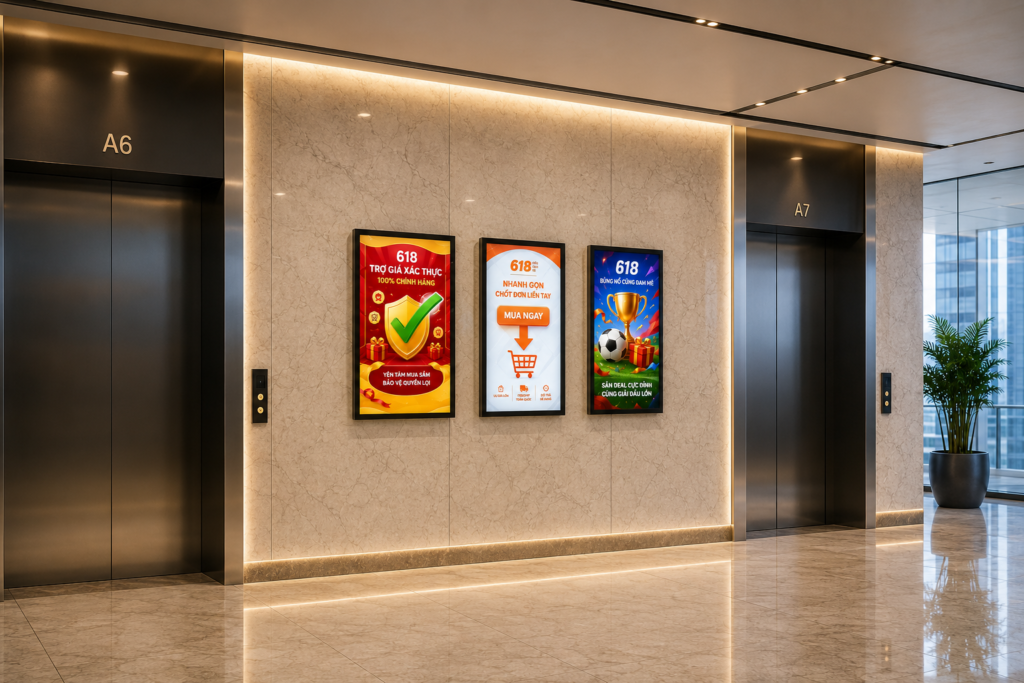
The technical question — whether the media network is fast enough and broad enough to support this model — has essentially been answered.
What remains is a question for brands themselves: have their content and creative teams already prepared different creative sets for weather conditions, events, and dayparts, or are they still operating with one fixed creative throughout the entire campaign?
Is media budget being allocated flexibly according to real-world data, or is it still locked into a rigid media schedule approved at the beginning of the month?
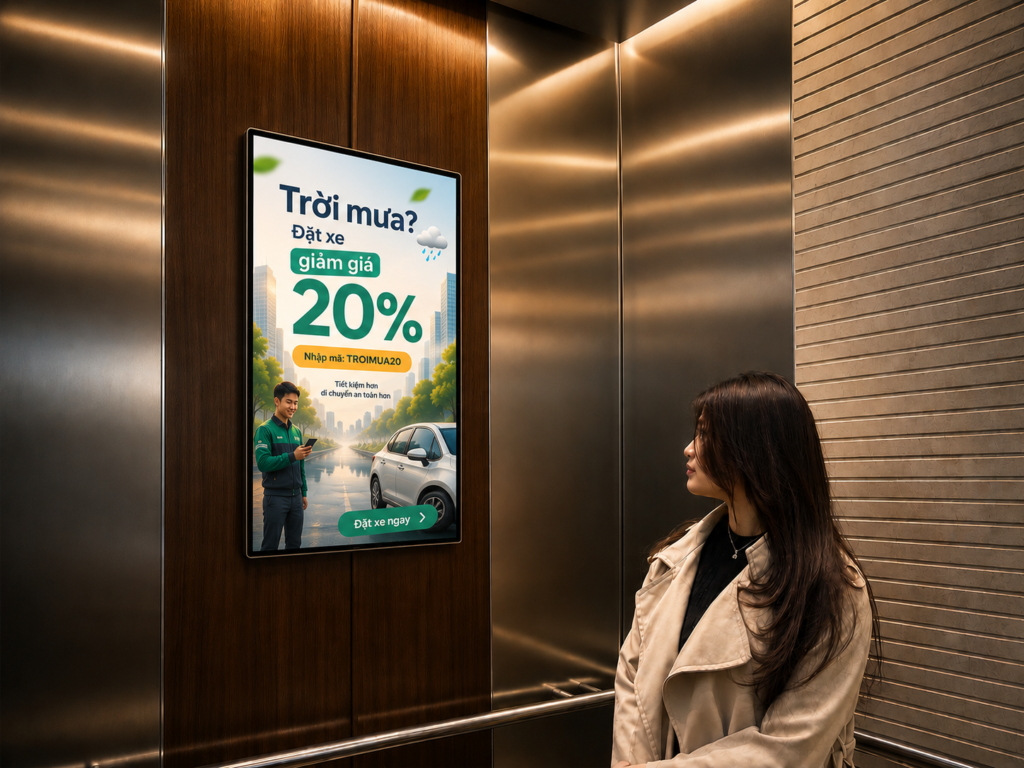
More than 18,000 Elevator Media Screens nationwide, infrastructure ready to operate with real-time data, and an NFC touchpoint capable of turning attention into action — the tools are already there.
The brand that arrives first with a contextual content strategy can capture the exact moment when competitors are still running the same creative regardless of whether it is raining or sunny outside, or regardless of what is happening that day.
Frequently Asked Questions (FAQ)
Q: What is remote data transmission via 5G on Elevator Media Screens?
A: It is a technology that enables advertising content on DOOH screens to be updated from a centralized system through 5G connectivity, without requiring personnel to visit each location and replace content manually. As a result, content can be updated in near real time and aligned more closely with external data such as weather conditions, live events, and different times of day.
Q: How many Elevator Media Screens has Focus Media Vietnam equipped with 5G infrastructure?
A: At “The New Era Of Elevator Media” event in July 2026, Focus Media Vietnam announced that it had completed its 5G data transmission infrastructure across its entire nationwide network of more than 18,000 Elevator Media Advertising Screens.
Q: What is weather-triggered DOOH, and is there evidence that it works?
A: Weather-triggered DOOH is a form of DOOH in which content automatically changes according to actual weather conditions. The model has already been demonstrated internationally. “The Guinness Brewery of Meteorology” campaign in Australia won Gold at The Drum Awards 2024, while Vaseline’s campaign in Malaysia generated more than 1.65 million impressions by changing content according to the actual UV Index throughout the day.
Q: Besides weather, what other data can be used to change content on Elevator Media Screens?
A: Live events and breaking developments, such as FIFA World Cup 2026™ scores; environmental indicators, including UV levels and air quality; and different dayparts can all serve as variables for DOOH content — provided that the infrastructure is fast enough to update content in time.
Q: What is NFC used for on Elevator Media Screens?
A: NFC provides an interaction touchpoint that allows viewers to tap their phones directly at the elevator to book a ride, receive a discount code, or continue their journey on the brand’s app. It transforms a screen designed primarily for viewing into a touchpoint that can lead to a specific action. Focus Media Vietnam is deploying NFC in phases, with completion expected in September 2026.
Q: How can a brand begin deploying contextual content across Focus Media Vietnam’s network?
A: Brands need to prepare sets of content corresponding to the scenarios they want to activate — such as weather conditions, events, or dayparts — and work with the Focus Media Vietnam team to establish activation conditions for each content set through the Remote Data Transmission infrastructure. Contact the team using the information below for consultation tailored to your brand.
Câu Hỏi Thường Gặp Về Truyền Dữ Liệu Từ Xa 5G Trên DOOH Thang Máy
Hỏi: Truyền dữ liệu từ xa qua 5G trên màn hình thang máy là gì?
Đáp: Là công nghệ cho phép cập nhật nội dung quảng cáo trên các màn hình DOOH từ một hệ thống trung tâm, thông qua kết nối 5G, mà không cần cử người đến từng điểm để thay thủ công. Nhờ đó, nội dung có thể đổi gần như theo thời gian thực, bám sát dữ liệu đang diễn ra bên ngoài — thời tiết, sự kiện, khung giờ trong ngày.
Hỏi: Focus Media Việt Nam đã triển khai 5G trên bao nhiêu màn hình thang máy?
Đáp: Tại sự kiện "The New Era Of Elevator Media" tháng 7/2026, Focus Media Việt Nam công bố đã hoàn tất hạ tầng truyền dữ liệu 5G trên toàn bộ mạng lưới hơn 18.000 màn hình quảng cáo thang máy trên toàn quốc.
Hỏi: Weather-triggered DOOH là gì, và đã có bằng chứng nào cho thấy hiệu quả chưa?
Đáp: Là hình thức DOOH tự động đổi nội dung theo điều kiện thời tiết thực tế. Đây là hạng mục đã được kiểm chứng quốc tế: chiến dịch "Guinness Brewery of Meteorology" tại Úc từng giành Huy chương Vàng The Drum Awards 2024, còn Vaseline tại Malaysia ghi nhận hơn 1,65 triệu lượt hiển thị nhờ nội dung đổi theo chỉ số UV thực tế trong ngày.
Hỏi: Ngoài thời tiết, nội dung trên màn hình thang máy còn có thể đổi theo dữ liệu nào?
Đáp: Sự kiện và tin tức đang diễn ra (như tỉ số FIFA World Cup 2026™), chỉ số môi trường (UV, chất lượng không khí), và khung giờ trong ngày đều là những biến số đã được ứng dụng trong ngành DOOH — miễn hạ tầng đủ nhanh để cập nhật kịp thời.
Hỏi: NFC trên màn hình thang máy dùng để làm gì?
Đáp: NFC là điểm chạm cho phép người xem chạm điện thoại trực tiếp tại thang máy để đặt xe, nhận mã giảm giá, hoặc tiếp tục hành trình trên app của nhãn hàng — biến một màn hình chỉ để xem thành một điểm chạm dẫn tới hành động cụ thể. NFC đang được Focus Media Việt Nam triển khai theo từng giai đoạn, dự kiến hoàn thành trong tháng 9/2026.
Hỏi: Làm sao để một thương hiệu bắt đầu triển khai nội dung theo ngữ cảnh trên mạng lưới của Focus Media Việt Nam?
Đáp: Thương hiệu cần chuẩn bị các bộ nội dung tương ứng với từng kịch bản muốn khai thác (thời tiết, sự kiện, khung giờ...) và làm việc cùng đội ngũ Focus Media Việt Nam để thiết lập điều kiện kích hoạt cho từng bộ nội dung trên hạ tầng Remote Data Transmission. Liên hệ theo thông tin bên dưới để được tư vấn cụ thể cho thương hiệu của bạn.


Comment (0)
Related News

Do Elevator Media Bother Residents?
26/09/2026
 Contact
Let Focus Media Vietnam
Bring your brand into urban life
Share your campaign objectives. Focus Media Vietnam will advise on how your brand can appear at relevant touchpoints within the building and connect viewers to landing pages, e-commerce platforms, apps, or digital content.

No comments yet. Be the first to share your thoughts.