
 Tiếng Việt
 English
 中文
中文

Instant Retail and 5 Golden Moments for Brands to Convert Demand into Sales
Last updated: 09 Jun 2026Data from modern retail markets reveals a notable trend: consumers are increasingly shopping by the moment rather than according to a plan. As many as 68% of consumers say they no longer want to purchase products in advance for stockpiling. Instead, today’s growth race belongs to brands that can anticipate sudden needs and fulfill them within just 30 minutes.
Market Context and the Big Question
The modern generation of consumers, particularly Gen Z and young urban consumers, is redefining what shopping means.
Waiting several days for an item to arrive through traditional logistics is gradually becoming a less attractive experience. Consumer needs are no longer necessarily part of a long shopping list prepared in advance. Instead, they increasingly emerge at highly specific moments in everyday life.
The key question for marketers is:
How can a brand be present at the right time, in the right place, and in the customer’s mind at the exact moment an unexpected need arises — and convert that need into an immediate purchase?
5 Golden Moments Rewriting the Rules of Retail
What these moments have in common is that demand emerges unexpectedly, purchase decisions happen extremely quickly, and the brand that responds more flexibly has the opportunity to capture the largest share of the market opportunity.
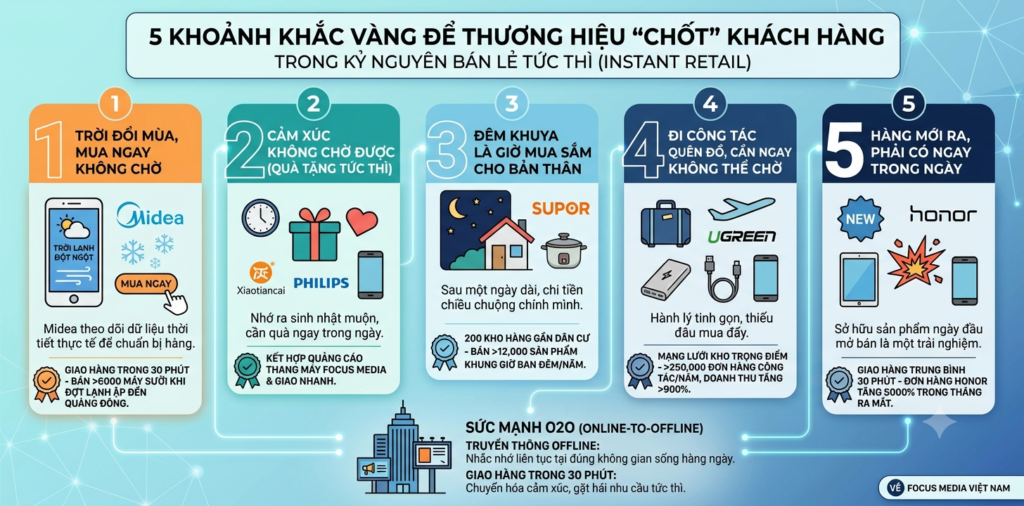
When the weather changes, consumers buy immediately rather than wait: Consumers no longer necessarily buy fans in spring or prepare heaters at the beginning of winter. They wait until it actually becomes hot or cold before making a purchase. Midea monitored real-time weather data to prepare inventory in advance across different regions. When an unexpected cold wave arrived, Midea immediately sold more than 6,000 heaters within just a few hours, supported by its 30-minute delivery service.
Emotions cannot wait — instant gifting: Remembering a friend’s birthday in the morning and wanting the gift delivered that same day, or choosing a present shortly before a date, has become one way younger consumers express thoughtfulness. Major brands such as Xiaotiancai and Philips combined high-frequency Elevator Media Advertising to activate demand, then partnered with instant-delivery platforms to deliver products within half an hour, helping drive a surge in sales during holiday occasions.
Late night becomes a time for self-reward shopping: After a long and busy day, late at night is when consumers may be more willing to spend money to indulge themselves. Recognizing this need for comfort and self-care, Supor established nearly 200 warehouses close to residential communities to ensure that products such as health-preserving cooking pots could be delivered within 30 minutes regardless of the hour. During nighttime hours alone, Supor sold more than 12,000 products per year.
Forgotten essentials on a business trip — needed immediately: The rise of “light travel” has created scenarios in which consumers arrive in a new city only to realize they have forgotten a power bank, charging cable, cosmetics, or other essentials. UGREEN became a leader in this segment by building a dense warehouse network across key cities, generating more than 250,000 business-travel-related orders in one year and driving revenue growth of more than 900%.
A new product launches — consumers want it on day one: For technology enthusiasts, owning a product on the first day it goes on sale — such as the iPhone 17 or Huawei Mate 80 — is part of the core product experience. Honor achieved a remarkable 5,000% increase in orders during the first month of launch by committing to an average delivery time of 30 minutes as soon as products became available online.
Touchpoints and the Value of an Integrated Solution
This shift requires brands to build an integrated Online–Offline (O2O) solution capable of capturing every relevant touchpoint throughout the Customer Journey:
Offline — Pulling the trigger in the consumer’s mind: As consumers move through their everyday living environments — including building elevators and shopping malls — high-frequency advertising repeatedly reinforces brand memory and helps establish the brand more deeply in their minds.
Online — Converting emotion into action: The moment a need emerges — whether consumers have forgotten an essential item, the weather suddenly changes, or they need a gift — they can immediately search through an app. With an optimized warehousing and logistics network, the product can reach them within just 30 minutes.
Why This Matters for Major Product Categories
This “moment capture” model is no longer limited to technology products or home appliances. It is rapidly expanding across other categories, from F&B and fashion to pharmaceuticals and healthcare.
For example, in pharmaceuticals and wellness, demand may emerge when consumers suddenly feel unwell after work or require urgent healthcare products late at night.
The brand that has already built strong and credible Brand Awareness through offline media channels, while simultaneously maintaining a presence on 24/7 instant-delivery platforms, will be in the strongest position to capture that demand.
Actions and Results from Major Brands
Campaign examples from Midea, Supor, and UGREEN demonstrate that shifting from the mindset of “selling available products” to “selling solutions for specific contexts” can generate significant results:
Optimize the supply chain using real-world data such as weather conditions and geographic location.
Turn traditionally low-demand periods, such as late-night hours, or urgent situations, such as forgotten essentials, into valuable revenue opportunities.
Transform “fast delivery” from a logistics function into a core competitive advantage of the product offering.
Looking Ahead
A saturated market is not necessarily the greatest threat. The greater risk is when a brand fails to identify new contexts in which customer needs emerge.
The Instant Retail revolution is opening a new chapter in which the distance between “wanting” and “having” is being reduced to a minimum.
In the near future, businesses that know how to combine the power of continuous offline media visibility with the ultra-fast fulfillment capabilities of online systems will be best positioned to lead the market.
Is your business already present in customers’ minds before their needs arise? Leave a comment or contact us to discuss strategies for building communications coverage and optimizing the most effective touchpoints.
About Focus Media Vietnam
Focus Media Vietnam is a pioneering and leading provider of Elevator Media Advertising and Digital Out-of-Home (DOOH) advertising in Vietnam.
With a network of tens of thousands of LCD screens and Posters across office buildings, premium residential developments, and shopping malls nationwide, Focus Media provides a strategic solution that helps brands strengthen Brand Awareness, maintain continuous visibility throughout consumers’ everyday environments, and remain ready to activate every “golden moment” of purchase.


Comment (0)
Related News

Do Elevator Media Bother Residents?
26/09/2026
 Contact
Let Focus Media Vietnam
Bring your brand into urban life
Share your campaign objectives. Focus Media Vietnam will advise on how your brand can appear at relevant touchpoints within the building and connect viewers to landing pages, e-commerce platforms, apps, or digital content.

No comments yet. Be the first to share your thoughts.