
 Tiếng Việt
 English
 中文
中文

Media guide
How NFC Technology Works on Elevator Media Screens
Last updated: 04 Jul 2026NFC is opening up a new way to interact with Elevator Media Screens: users can tap their phones to move from an offline advertisement to a landing page, promotional offer, app, or other digital content provided by the brand.
But how does NFC actually work? Does it collect personal data? Who controls the destination link after the tap? And how can this technology support campaign measurement?
This article explains how Focus Media Vietnam deploys NFC on Elevator Media Screens, from its operating principles and control processes to the role NFC plays in the O2O journey.
What Is NFC on an Elevator Media Screen?
NFC, short for Near Field Communication, is a short-range wireless communication technology.
In everyday user experiences, NFC is commonly associated with actions such as tapping a phone to make a payment, tapping a card to unlock a door, or tapping an interaction point to open digital content.
Across its Elevator Media Screen network, Focus Media Vietnam deploys NFC as an interactive touchpoint connecting offline advertising with the digital customer journey.
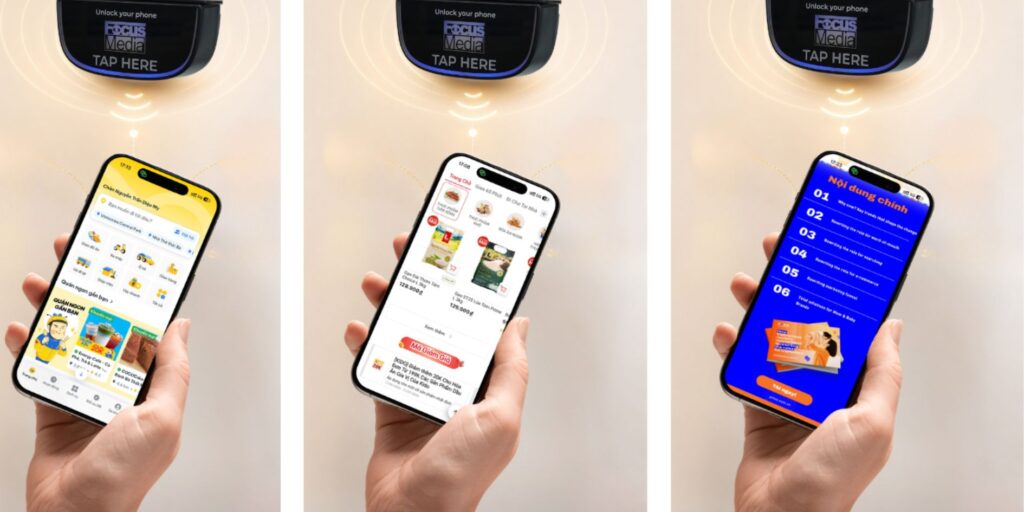
Instead of simply viewing a message on the screen, users can actively tap their phones on the NFC touchpoint to open a pre-configured destination, such as a landing page, promotional program, registration form, product information page, or interactive brand content.
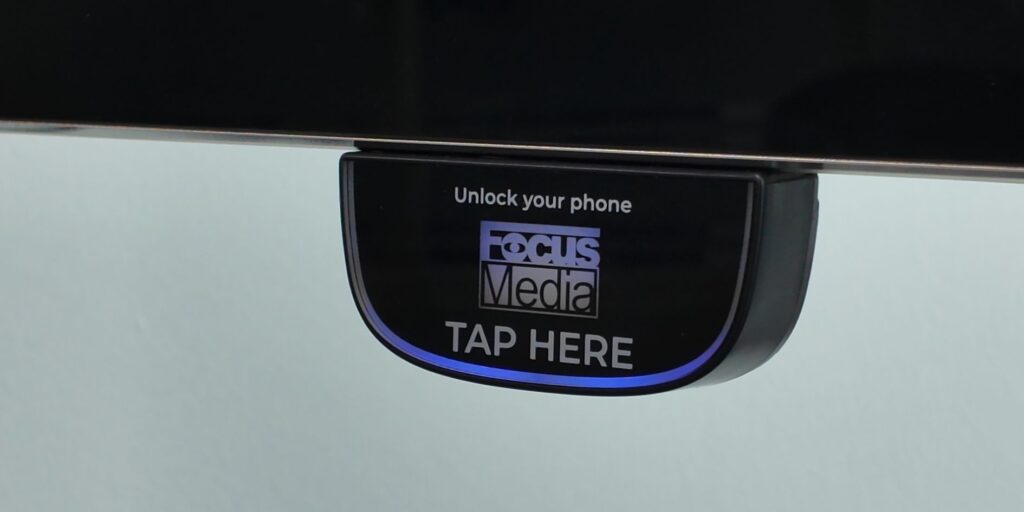
An important point is that NFC does not replace the advertising screen.
NFC adds a next step after the viewer has already paid attention to the content displayed on the screen. This is how Elevator Media can move beyond its display role and become a bridge connecting the offline environment with the online journey.
How Does a User Tap NFC on an Elevator Media Screen?
For users, the NFC interaction is simple.
While in the elevator area, if users see advertising content with an interaction prompt, they can bring an NFC-enabled smartphone close to the touchpoint. If the device is compatible and NFC is enabled, the phone will display a link or notification prompting the user to open the destination page.
The user remains in control of whether to continue.
NFC interaction is a deliberate user action. It does not happen automatically simply because someone walks past the screen.
Within Focus Media Vietnam’s deployment model, the NFC touchpoint acts as a bridge that takes users from the Elevator Media Screen to the campaign’s digital content.
This can support activities such as:
receiving vouchers;
joining a minigame;
registering interest;
learning more about a product;
opening an app;
visiting the brand’s e-commerce page.
Does an NFC Tag Collect Personal Data From the User’s Phone?
With the passive NFC tag configuration used to open a link, the NFC tag itself does not have the capability to read personal data back from the user’s phone.
The NFC tag does not automatically access contacts, phone numbers, email addresses, images, applications, or personal files stored on the device.
It is important to distinguish between two layers in this journey.
The first layer is the NFC tag. This is the touchpoint used to open a pre-configured link.
The second layer is the destination page that the user accesses after tapping.
If the user only taps the NFC tag to open a link, the NFC tag functions solely as a link trigger.
If the user then fills in a form, claims a voucher, creates an account, or provides information on the brand’s landing page, that data belongs to a separate processing layer managed by the destination-page operator. It should be handled according to the operator’s data policy and in compliance with applicable personal-data protection regulations.
Therefore, when evaluating an NFC touchpoint, the question should not simply be:
“Does the NFC work?”
The more appropriate questions are:
Where does the touchpoint lead?
What information does the destination page request?
Who manages the data after the user continues the interaction?
Is the user actively choosing to take that action?
Why Do NFC Touchpoints on Elevator Media Screens Need to Be Controlled?
Users today have good reason to be cautious about digital touchpoints.
International warnings involving fraudulent QR codes, suspicious links, or replaced interaction points show that the risk does not lie only in the act of scanning or tapping. It also lies in the destination behind that interaction point.
For NFC on Elevator Media Screens, Focus Media Vietnam approaches this issue through three layers of control.
First: Location Control
NFC touchpoints are deployed together with existing screen systems inside office buildings, residential developments, and shopping malls with building management, rather than existing as isolated interaction points in uncontrolled open spaces.
Clearly defined installation locations allow building management teams and property owners/developers to inspect the equipment and coordinate responses when necessary.
Second: Device Control
According to technical information provided by Focus Media Vietnam, NFC devices are fixed to the screen structure using dedicated mounting brackets or locking frames.
This installation method is designed to reduce the risk of the device being peeled off, replaced, or tampered with arbitrarily, as can happen with standalone interaction points.
Third: Link Control
The destination URL associated with the NFC touchpoint must be created, updated, and managed through the system by authorized personnel.
External organizations or devices do not automatically have access to the administration system and cannot independently change the content associated with the NFC touchpoint.
These control layers should not be interpreted as eliminating every possible risk.
Their proper meaning is that NFC touchpoints should be deployed in a managed environment, using fixed devices, role-based access controls, and coordinated inspection procedures when required.
Does NFC Affect a Building’s Technical Systems?
According to technical information provided by Focus Media Vietnam, the NFC device operates independently and is not connected to core building systems such as:
internal LAN/WiFi networks;
Building Management Systems;
elevator control systems;
camera systems;
internal IT infrastructure.
This helps keep the NFC touchpoint separated from the building’s critical technical infrastructure.
From an operational perspective, this is an important consideration for building management teams and property owners/developers when assessing risk before approving installation.
The device is also mounted together with the existing screen system. It does not require users to stop the elevator, does not interfere with the elevator control system, and does not alter the building’s technical infrastructure.
What Can NFC Do After a Viewer Notices the Advertising Content?
In traditional Elevator Media Advertising, the main touchpoint is the screen.
Viewers see the message, remember the brand, or become aware of a promotional program.
With NFC, brands can add a next step.
After paying attention to the advertisement, viewers can actively tap the NFC touchpoint and continue to a specific piece of digital content.
Depending on campaign objectives, NFC on Elevator Media Screens can be used to:
direct users to a product landing page;
open a voucher or promotional code;
direct users to an app or account-registration page;
connect users to an e-commerce storefront;
collect program registrations when users voluntarily provide information;
record interaction signals such as taps, visits, or subsequent actions on the brand’s platform.
These signals give advertisers an additional layer of information for reviewing campaign performance.
Instead of knowing only that the advertisement was played on the screen, brands may also gain data on the extent to which viewers actively continued interacting after exposure.
However, it is important to clarify that Focus Media Vietnam does not automatically own all conversion data generated after users reach the brand’s landing page.
Data such as registrations, purchases, add-to-cart actions, or completed transactions depends on the brand’s own platform and is shared only according to the specific implementation agreement.
How Can NFC Support Measurement of Elevator Media Advertising Effectiveness?
NFC does not turn Elevator Media Advertising into a channel that measures the entire purchase journey end to end.
However, NFC can add an important layer of measurement: active interaction signals from viewers.
For campaigns with a clearly designed O2O journey, brands can monitor signals such as:
number of NFC taps;
landing-page visits generated from the NFC touchpoint;
voucher claims or program participation;
form-completion rates if the landing page contains a form;
onward traffic to an app, website, or e-commerce platform when appropriate tracking has been implemented.
In several international cases conducted by Focus Media Group in cooperation with Alibaba, shared data showed that after exposure to advertising on Elevator Media Screens, the number of users actively searching for the brand within the app increased by 126%, while the number of users adding products to their shopping carts increased by 95%.
In Vietnam, the key value of NFC on Elevator Media Screens lies in enabling campaigns to be designed around clearer interactive touchpoints.
When Elevator Media Screens, Remote Data Transmission, NFC, and reporting dashboards are combined, advertisers gain more information to evaluate which creative generates stronger responses, which touchpoints produce higher interaction levels, and how future campaigns can be optimized.
Why Is NFC Suitable for Next-Generation Elevator Media?
Elevator Media is no longer simply about “where an advertisement is seen.”
For Focus Media Vietnam, the direction of next-generation Elevator Media lies in combining location, content, interaction, and data.
Elevator Media Screens enable brands to appear in office buildings, residential developments, and shopping malls.
Remote Data Transmission infrastructure enables content to be updated more flexibly according to timing or campaign stages.
NFC creates an active interaction step for viewers.
Dashboards and interaction signals give advertisers additional information for reviewing campaign effectiveness.
In other words, NFC is one component of the O2O ecosystem of Elevator Media:
from offline screen to online action,
from awareness to interaction,
from advertising delivery to recorded response signals.FAQs About NFC on Elevator Media Screens
1. Are users required to tap NFC?
No. NFC is an active, voluntary interaction. Users can choose whether or not to tap.
2. Does NFC automatically collect phone numbers or contacts?
With the passive NFC tag configuration used to open links, the NFC tag itself cannot read contacts, phone numbers, email addresses, images, or other personal data stored on the user’s phone.
3. If users submit information on the landing page, who controls that data?
Data voluntarily submitted by users on the landing page belongs to a separate processing layer managed by the destination-page operator, typically the brand or campaign implementation partner.
The processing of that data should comply with applicable personal-data protection regulations.
4. Can an external party independently change the URL stored on the NFC touchpoint?
According to operating information provided by Focus Media Vietnam, NFC destination links are managed through the system by authorized personnel.
External organizations or devices do not automatically have access to the administration system and cannot independently modify the content associated with the NFC touchpoint.
5. Does NFC affect the elevator system?
According to technical information provided by Focus Media Vietnam, the NFC device operates independently and is not connected to the elevator system, internal network, or Building Management System.
6. What can NFC on Elevator Media Screens help measure?
NFC can support the recording of interaction signals such as taps, landing-page visits, or subsequent actions when those actions are configured within the campaign flow.
Deeper conversion data — including registrations, purchases, or add-to-cart actions — depends on the brand’s own platform and the specific implementation agreement.
Conclusion
NFC touch technology on Elevator Media Screens is more than a new interaction method in the advertising experience.
When implemented correctly, NFC can become a bridge between the offline environment and the user’s digital journey.
The key question is not simply whether the interaction is “fast to tap.”
What matters is:
the environment in which the touchpoint is installed;
how the device is physically secured;
who manages the destination link;
how much control the user retains;
and how far interaction data is actually recorded.
For Focus Media Vietnam, NFC represents one step in the development of next-generation Elevator Media: selecting the right touchpoints, updating content more flexibly, enabling O2O interaction, and providing advertisers with additional signals for clearer campaign evaluation.
Further reading: Focus Media Vietnam pilots World Cup score updates through Remote Data Transmission technology (5G)


Comment (0)
Related News






 Contact
Let Focus Media Vietnam
Bring your brand into urban life
Share your campaign objectives. Focus Media Vietnam will advise on how your brand can appear at relevant touchpoints within the building and connect viewers to landing pages, e-commerce platforms, apps, or digital content.

No comments yet. Be the first to share your thoughts.