
 Tiếng Việt
 English
 中文
中文
Media guide
DOOH & Digital – A Marketing Funnel Strategy for Businesses
Last updated: 01 May 2026For many years, Out-of-Home advertising — and Elevator Media Advertising in particular — was often treated as a “standalone brand awareness channel”: the advertisement was displayed, awareness was created, and the journey ended there. There was no retargeting, no audience tracking, and no bridge taking viewers from an LCD screen inside an elevator to the brand’s landing page.
But the era of DOOH (Digital Out-of-Home) has fundamentally changed that logic.
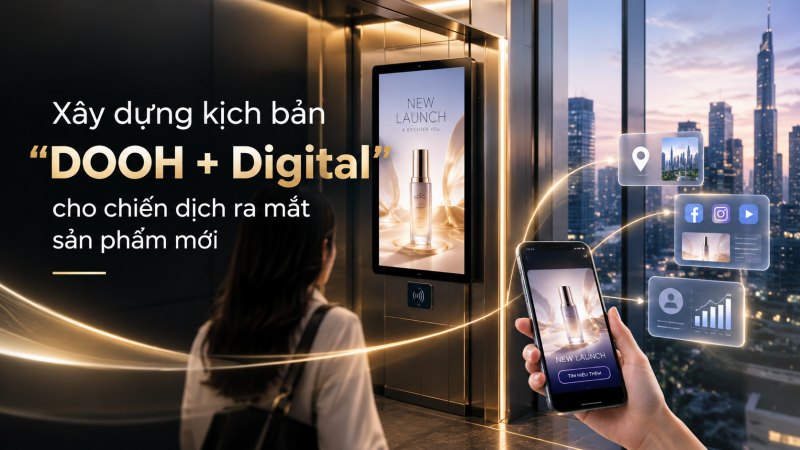
DOOH is not merely a “digitized” version of a static billboard. When properly integrated into the marketing ecosystem, Elevator Media Advertising can play a strategic role at every stage of the conversion funnel — from activating initial awareness, nurturing consideration, to coordinating with Digital channels to drive conversion.
This article provides a systematic framework for thinking about and implementing an integrated DOOH and Digital strategy.
What Is DOOH and Why Is It Different from Traditional OOH?
DOOH stands for Digital Out-of-Home — Out-of-Home advertising delivered through digital screens, with the ability to change content flexibly, automate scheduling, and, in many cases, integrate data to serve Target Audiences more precisely.
Compared with traditional OOH formats such as banners, lightboxes, and static decals, DOOH offers several important strategic advantages:
| Criteria | Traditional OOH | DOOH |
|---|---|---|
| Content updates | Manual and costly | Immediate via a cloud-based CMS |
| Content segmentation | Not available | By time, day, and location |
| Measurement | Manually estimated traffic | Impression tracking, audience data |
| Digital integration | No | Yes — via pixels, QR codes, geo-data |
| Deployment speed | 3–7 days | Several hours to 24 hours |
Within elevator environments, DOOH provides an additional advantage: an enclosed environment, controlled exposure time, and high repeat frequency among the same groups of residents or office workers.
This makes Elevator Media Advertising an ideal starting point for building an Omnichannel marketing funnel.
Strategic Thinking: DOOH Is Not the End Point — It Is the Starting Point
One of the most common mistakes when deploying DOOH is designing it as a standalone, closed-loop channel: install the screens, display the content, report the impressions, and stop there.
This mindset overlooks the channel’s greatest potential.
Instead, think of DOOH through a “trigger & retarget” model:
DOOH creates the first layer of awareness in a physical environment where users are not yet actively searching and may not have clear intent.
Digital continues the journey, following users across social media, search engines, email, and apps to nurture and convert them.
When these two channels work together, brands no longer depend on the chance of “meeting the right person at the right time.” Instead, they can deliberately create a continuous journey from the physical world into the digital world.
How to Integrate Elevator Media Advertising Into a Digital Marketing Funnel
Awareness: DOOH “Plants the Seed”
At the top of the funnel, the objective is to build brand recall among the Target Audience.
Elevator Media Advertising is particularly effective at this stage because of:
High exposure frequency: Residents or office workers may see an advertisement 3–8 times per day, creating natural repetition without triggering the same “skip ad” response seen online.
A low-competition environment: There are no competing browser tabs, scrolling newsfeeds, or interruptive notifications — viewers are more likely to actually look at the screen.
Geographically precise access to ABC1 segments: Brands can select specific buildings, districts, and property types.
Awareness integration tactic: Run DOOH alongside display remarketing on the Google Display Network or Meta Advantage+. Digital audiences can be targeted using geographic and demographic criteria aligned with the buildings covered by the DOOH campaign, creating an “omnipresence effect” that makes the brand feel more familiar and credible.
Consideration: Connect DOOH to an Online Conversion Point
Once awareness has been established, the next task is to move users into the digital journey so they can learn more.
This is where QR codes and branded search become valuable.
Dynamic QR code integration: Next-generation DOOH screens can display QR codes that change in real time, leading to:
Campaign landing pages
Specific product/service pages
Time-limited vouchers
Consultation registration forms
QR codes do more than generate measurable traffic from DOOH. They can also create valuable first-party data points: who scanned, when they scanned, which building they scanned from, and what they did afterward on the website.
This is a type of data that traditional OOH cannot generate.
Activate branded search: When users see a brand repeatedly on Elevator Media Screens, they may begin to search for the brand independently on Google.
Brands should ensure that Google Search Ads continue bidding on branded keywords throughout the DOOH campaign period to avoid losing users at the final stage of this naturally generated search journey.
Conversion: Complete the Loop With Retargeting
This is the most important stage — and also the one many brands leave underdeveloped when running DOOH.
Geo-targeting combined with retargeting: Some advanced DSPs (Demand-Side Platforms) allow advertisers to create a geo-fence around buildings containing DOOH screens, and then retarget users who have been present within those defined areas through mobile advertising.
The process works as follows:
A user enters the building/elevator environment → the mobile device records location data
The DSP identifies the device as having been present within the defined geo-fence
Over the next 24–72 hours, the device receives retargeting ads across mobile apps, newsfeeds, or YouTube
Digital advertising continues the message first seen on the Elevator Media Screen and directs the user to a landing page or online store
Social proof amplification: If the DOOH campaign includes an interactive element such as a hashtag, challenge, or competition, amplify it across Instagram, TikTok, or Facebook to create a loop:
DOOH exposure → online participation → user-generated content spreads → awareness increases → additional audiences are influenced, including those who were not directly exposed to the original DOOH campaign.
Measuring the Effectiveness of Integrated DOOH + Digital
One of the biggest barriers when convincing management teams to invest in DOOH is the recurring question:
“How do we measure it?”
Below is a practical measurement framework.
Awareness Metrics:
Branded Search Lift: Compare branded keyword search volume during and outside the DOOH campaign period
Brand Recall Survey: Survey residents or office workers in target buildings before and after the campaign
Organic Social Mentions: Track mentions of the brand across social platforms
Consideration Metrics:
QR Scan Rate: Number of QR scans relative to total impressions
Landing Page Traffic from DOOH-specific UTM sources
Time on Site and Bounce Rate for traffic generated via QR — indicators that help assess audience quality
Conversion Metrics:
Conversion Rate of geo-fence retargeting segments compared with cold audiences
Cost per Acquisition (CPA) among DOOH-exposed audiences compared with audiences exposed only to Digital
Store Visit Uplift, where Google Ads Store Visit integration is available
Checklist for Launching an Integrated DOOH + Digital Campaign
Before launching, make sure the following steps are in place:
✅ Prepare the Technical Foundation:
Install tracking pixels such as Meta Pixel and Google Tag across all landing pages
Create DOOH-specific UTM parameters, for example:
utm_source=dooh / utm_medium=elevatorSet up geo-fence audiences on the DSP or relevant Meta/Google platforms based on building coordinates
✅ Synchronize Creative Messaging:
Maintain a consistent visual identity between DOOH maquettes and Digital banners — including colors, typography, and tone of voice
Design messages according to a sequential logic: DOOH introduces → Digital explains → Landing Page closes
Avoid repeating exactly the same content across every channel; each channel should add another layer of information that moves the user deeper into the funnel
✅ Coordinate Campaign Scheduling:
Ensure the Digital campaign launches at the same time as DOOH or no more than 24 hours later
Increase retargeting budgets around peak DOOH exposure periods, such as 7–9 a.m. and 5–8 p.m.
Apply a frequency cap to Digital campaigns to prevent overexposure and negative audience reactions
Conclusion
When Elevator Media Advertising is designed as a strategic link within the marketing funnel rather than as a standalone channel, its value extends far beyond impression counts.
The real power of DOOH lies in its ability to capture physical moments of attention — those seconds inside an elevator that cannot easily be skipped or blocked — to seed awareness, and then continue nurturing that journey across the Digital platforms users engage with afterward.
Brands that understand and apply this integrated logic will not only run more effective DOOH campaigns, but will also build a broader marketing ecosystem that works in coordination, can be measured, and can be continuously optimized using real-world data.
With its cloud-based DOOH infrastructure and network covering ABC1 segments across major urban markets, Focus Media Vietnam provides a strong platform for beginning this integration journey.
Contact Focus Media Vietnam today to receive strategic consultation and a media kit aligned with your business objectives.


Comment (0)
Related News


 Contact
Let Focus Media Vietnam
Bring your brand into urban life
Share your campaign objectives. Focus Media Vietnam will advise on how your brand can appear at relevant touchpoints within the building and connect viewers to landing pages, e-commerce platforms, apps, or digital content.

No comments yet. Be the first to share your thoughts.