
 Tiếng Việt
 English
 中文
Elevator Advertising Displays: Types, Benefits & Costs
Last updated: 07 Nov 2026Elevator display screens are a form of digital door-to-door advertising (DOOH) that helps businesses reach customers in apartment buildings, office buildings, and commercial areas. With two popular formats, LCD and Digital Frame, brands can convey their message through images and videos during consumers' daily commutes. So, what types of elevator display screens are available, what are their benefits, and what are the implementation costs? Let's explore the details in the article below.
1. What are elevator advertising screens?
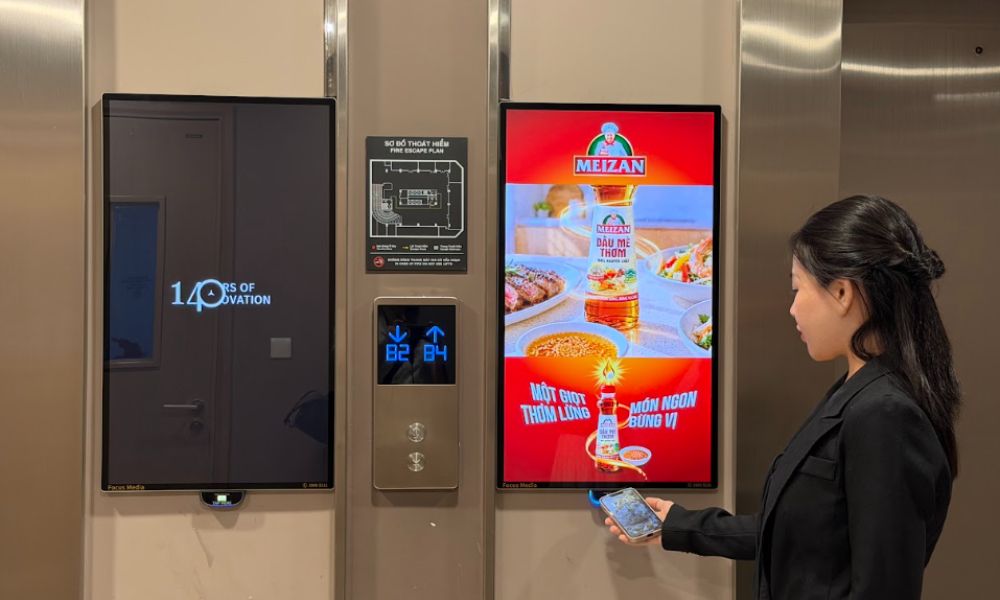
Elevator advertising screens are digital display devices installed in elevator lobbies or inside elevator cabins to display videos, images, and advertising messages. This is a form of out-of-home (DOOH) digital advertising , helping businesses reach consumers in apartment buildings, office buildings, and shopping malls.
Currently, the two most common formats are LCD screens (Elevator TVs) and Digital Frames (DFs) . LCD screens are typically placed in waiting areas to display TV commercials, while Digital Frames are primarily installed inside cabins, focusing on displaying product images and brand messages.
Advertisements are broadcast on a rotating schedule through a digital content management system. Businesses can lease airtime on an existing network of screens without having to invest in and operate their own equipment. This format creates opportunities for brands to appear in the daily commutes of residents and office workers.
2. Common types of elevator advertising screens
Currently, LCD screens (Elevator TVs) and Digital Frames (DFs) are two popular digital advertising formats in elevator communication systems. Each type has its own characteristics regarding installation location, display format, and message delivery, suitable for different communication objectives of businesses.
2.1. Elevator TV (LCD advertising screen)
At Focus Media Vietnam, the 6.0-inch LCD TV series features a 32-inch screen size , a horizontal design with a 16:9 aspect ratio, and a Full HD resolution of 1920 × 1080 pixels. This format is suitable for TV commercials and video advertising content, helping brands convey product images, messages, and usage scenarios visually.
Key features of LCD screens:
- Horizontal screen design: The 16:9 aspect ratio is suitable for popular TV commercials and advertising videos, helping businesses leverage existing media content.
- Location in the elevator lobby: The screen is positioned in the area where users gather while waiting, creating an opportunity for exposure to advertising content.
- Multimedia presentation: Supports video, animation, and TV commercials, suitable for messages that require product presentation through movement.
- Scheduled broadcast: Advertising content is broadcast on a rotating basis according to established durations and frequencies.
- Flexible content updates: TV commercials and messages can be adjusted at each stage of the campaign through the broadcast management system.
Applications: LCD screens are suitable for new product launch campaigns, brand building, feature introductions, or promotional programs. In particular, this format is ideal for businesses that want to use TV commercials to convey their message in a short amount of time.
2.2. Digital Frame (DF) advertising display in elevators
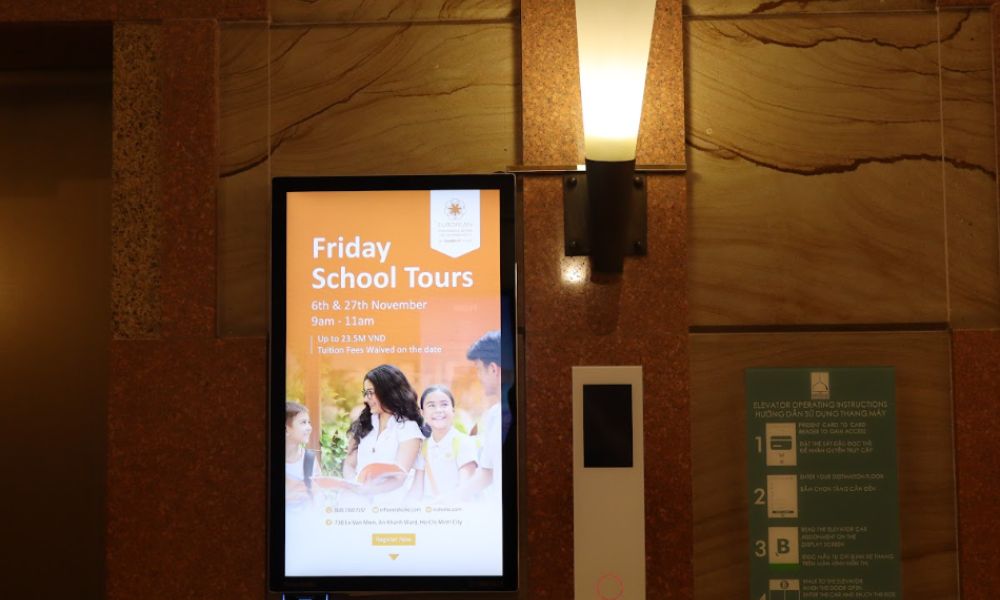
Digital Frame (DF) is a vertical digital advertising display, typically installed inside elevator cabins to show product images, key visuals, logos, and brand messages. Unlike horizontal LCD screens in lobbies, Digital Frame focuses on visual content that is concise and easily recognizable in a moving environment.
At Focus Media Vietnam, the Digital Frame 5.0 series features a 32-inch screen with a vertical 9:16 aspect ratio and Full HD 1080 × 1920 pixel resolution. This design allows businesses to display product images and advertising messages in a vertical layout, ideal for elevator cabin spaces.
Key features of Digital Frame:
- Vertical screen design: The 9:16 aspect ratio is suitable for product images, key visuals, and advertising content designed vertically.
- Display inside the elevator cabin: Screens are positioned within the elevator's travel space, allowing users to interact with the message at close range.
- Focus on a concise message: This should align with the logo, slogan, product images, and easily recognizable advertising content.
- Create opportunities for repeated exposure: The brand can appear multiple times during the daily elevator use of residents and office workers.
- Flexible content changes: Images and messages are managed according to a schedule, supporting updates at each stage of the campaign.
Applications: Digital Frames are suitable for campaigns to increase brand awareness, remind customers of their brand, promote products, and communicate special offers. To suit the time spent in elevators, businesses should prioritize eye-catching images, minimal text, and messages that are easily understood at first glance.
2.3. Comparison of LCD and Digital Frame elevator displays
Although both fall under the category of out-of-home (DOOH) digital advertising, LCD and Digital Frame advertising differ in design, placement, and message delivery.
Criteria | LCD screen (Elevator TV) | Digital Frame (DF) |
Popular locations | Elevator waiting area | Inside the elevator cabin |
Display format | TV commercial, video, animated image | Images, key visuals, advertising slides |
Reference duration at Focus Media | 15 seconds | 10 seconds |
Access characteristics | Reach out to viewers while they wait for the elevator. | Reach viewers while they are in motion. |
Media advantage | Conveying messages through animation. | Focus on images and short messages. |
Appropriate goals | Launching the product, building brand identity. | Brand reminders, maintaining presence, promoting offers. |
Note: The ad duration is a reference based on the configuration published by Focus Media and may vary depending on the package.
See also: Types of Elevator Advertising: Comparison & How to Choose
Should you choose an LCD screen or a Digital Frame? Depending on your communication goals, businesses can choose an LCD screen to display TV commercials, introduce products, and attract attention in the waiting area. Meanwhile, a Digital Frame is suitable for product images, logos, and short messages to increase brand recall in the cabin. Combining both formats expands touchpoints and increases opportunities for customer interaction during their daily commute.
3. Benefits of elevator screen advertising for businesses
3.1. Increase opportunities for brand exposure and recall.
One of the advantages of elevator screen advertising is its ability to be repeatedly displayed during daily commutes. Apartment residents and office workers can be exposed to the same advertising message multiple times as they enter and exit the building.
Maintaining a presence at familiar touchpoints creates opportunities to reinforce brand recognition and memorability. Especially for new product launches or long-term brand building campaigns, consistency in imagery and messaging across impressions can help consumers better identify the product.
3.2. Approaching customers based on building location and characteristics
Elevator screen advertising allows businesses to choose the geographic area and building type that best suits their target customers. For example, apartment buildings are a potential touchpoint for consumer goods, household goods, and home services brands; while office buildings are suitable for considering advertising in finance, technology, and F&B.
By selecting locations based on area, building characteristics, and user data, businesses can focus their budget on relevant touchpoints, rather than distributing ads broadly.
3.3. Conveying visual messages through images and videos
Elevator advertising allows for the display of TV commercials, product images, and brand messages. LCD screens are suitable for video content, product introductions, and feature presentations, while digital frames are ideal for key visuals, logos, and short messages.
To capture attention while waiting or using an elevator, advertising content should use striking visuals, minimal text, and focus on a single key message. This approach makes it easy for viewers to absorb the information even during short viewing times.
3.4. Flexible management and updating of advertising content.
Compared to printed advertising materials, digital screens allow businesses to change content through a management system without having to replace images directly at each location.
Depending on the system's capabilities, businesses can deploy multiple versions of advertisements at different stages of the campaign, for example:
- Launch phase: Introducing the new product, its visuals, and its core message.
- Awareness phase: Maintaining brand presence and emphasizing product benefits.
- Action-driven phase: Communicating offers, promotions, or calls to action.
In addition, advertising content can incorporate QR codes or NFC technology at key locations to connect viewers with websites, landing pages, or consultation programs. This provides businesses with additional interaction data to evaluate campaign effectiveness alongside broadcast metrics.
4. Where are elevator advertising screens installed?
4.1. Screens in the elevator lobby
Lobby screens typically use a horizontal LCD format and are positioned in the area where users wait for elevators. This is an ideal location for displaying TV commercials, introducing new products, or conveying brand messages through moving images.
Because elevator waiting times vary by building and time of day, advertisements should feature eye-catching visuals from the very first seconds, a clear message, and be easily understood even without sound.
4.2. Screen inside the elevator cabin
Digital Frame screens are typically positioned inside the cabin, using a vertical design to display product images, logos, and short advertising messages. This placement creates additional touchpoints as users move between floors.
With limited cabin space and viewing time, businesses should prioritize a single key message, a striking visual, and text large enough for easy readability. Content such as product introductions, promotions, or brand identity information can be presented in this format.
4.3. Screens in apartments, offices, and shopping malls
Elevator-based advertising display systems can be deployed in various types of buildings, depending on the provider's network. Apartment buildings are a suitable touchpoint to consider reaching residents; office buildings target working professionals; and shopping malls can reach shoppers and service users.
When choosing advertising locations, businesses need to consider the geographic area, user characteristics, traffic flow, and the actual list of screen locations. These are crucial factors in developing a suitable advertising budget allocation plan.
5. How to choose an effective elevator advertising screen.
To optimize advertising budgets, businesses need to choose between LCD or Digital Frame displays, but also assess the suitability between screen placement, target audience, advertising content, and campaign goals.
5.1. Prioritize screen placement that is suitable for the target audience.
Instead of choosing a location based solely on the number of screens, businesses should consider geographic location, building segment, user characteristics, and traffic flow . For example, a high-end furniture brand might prioritize apartments in a suitable segment, while a business service provider should consider office buildings.
When planning, it's necessary to compare the list of buildings with the actual number of screens to avoid allocating budget to locations with low likelihood of reaching the target customer.
5.2. Choosing between LCD or Digital Frame based on communication objectives
LCD screens in the lobby are suitable for TV commercials showcasing product features, experiences, or brand stories. Digital frames in the cabins are ideal for short messages, product images, and memorable brand identities.
If implementing a combined approach, businesses should assign specific roles to the content: LCD screens convey the main message, while digital frames highlight the product or call to action. This allows the two formats to complement each other instead of displaying the same, less optimal content.
5.3. Optimizing content based on time and exposure conditions.
Viewers may only be exposed to the advertisement for a portion of the broadcast time. Therefore, the brand and its outstanding benefits should be prominent from the beginning , regardless of whether viewers watch the entire TV commercial.
With LCD screens, prioritize video that still conveys the main message even when muted. With Digital Frames, use a clear main image, sufficiently large text, and a central message. Content must be specifically designed to fit the screen aspect ratio and technical requirements of each format.
5.4. Measuring effectiveness according to each campaign objective
For brand recognition purposes, businesses need to check location coverage, screen count, frequency of broadcasts, and broadcast evidence . To assess brand recall or awareness, pre- and post-campaign surveys can be conducted instead of relying solely on broadcast counts.
With the goal of generating leads, QR codes, NFC tags, or dedicated landing pages can be used to measure visits and conversions. However, these interactions only reflect a fraction of the effectiveness and do not represent everyone who has been exposed to the advertisement.
6. Elevator advertising solutions at Focus Media Vietnam
Focus Media Vietnam provides digital elevator advertising (DOOH) solutions, combining interactive and measurement technology to help businesses reach customers in apartment buildings, office buildings, and shopping malls.
According to data published on its website on October 1, 2026, Focus Media Vietnam owns a network of 19,279 screens in 1,712 locations , with an estimated media reach of 463.6 million impressions and 22 million impressions per month , enabling brands to expand their reach and increase brand awareness.
Why choose Focus Media Vietnam?
- Extensive network coverage: LCD screens and digital frames are installed in numerous buildings, supporting campaign deployment based on specific regions and target customer groups.
- Data-driven planning: Screen IQ tools help select ad placements that align with your communication goals.
- Increase engagement with NFC: Connect ads to websites, landing pages, or NFC Mini Apps, helping customers learn about products and take action.
- Effective monitoring: Supports broadcast monitoring, aggregates interaction data, and evaluates campaign results.
Contact Focus Media Vietnam for elevator advertising consultation.
Are you looking for elevator advertising solutions that help your brand reach the right customers and optimize your marketing budget? Contact Focus Media Vietnam today for advice on placement, implementation plans, and a quote tailored to your business campaign.
7. Frequently Asked Questions about Elevator Displays (FAQ)
7.1. What types of elevator advertising screens are available?
The two most common types are LCD (Elevator TV) and Digital Frame (DF) . LCDs are typically designed horizontally and placed in lobbies to display TV commercials; Digital Frames are designed vertically and installed inside cabins to display product images and short messages.
7.2. How much does it cost to rent an elevator advertising screen?
Costs depend on the type of screen, building location, number of advertising points, deployment time, and broadcast frequency. Businesses need to provide the area, target audience, and expected timeframe to receive a suitable quote.
7.3. Is the effectiveness of elevator screen advertising measurable?
Yes. Businesses can check screen counts, broadcast schedules, and broadcast data to evaluate deployment. With campaigns incorporating QR codes, NFC, or custom landing pages, additional tracking of visits, sign-ups, and conversions is possible. However, the number of broadcasts does not equate to the actual number of people who viewed the ad.
7.4. Is it possible to change the TV commercial or images during the advertising campaign?
This may depend on the contract terms and operating procedures of the provider. New content must meet requirements regarding size, format, and duration, and must be reviewed before being uploaded to the display system.
7.5. Should you advertise on LCD screens or Digital Frames?
LCDs are suitable for campaigns requiring the display of TV commercials, feature introductions, or brand storytelling. Digital frames are suitable for short messages and prominent product images. Businesses can combine the two formats to reach customers in both lobbies and elevator cabins.
Thus, elevator advertising screens are increasingly being used in DOOH (Do-Oh!) marketing campaigns, helping brands reach customers in apartment buildings and office buildings. Choosing the right LCD format, Digital Frame, and advertising location will contribute to improving communication effectiveness. Contact Focus Media Vietnam for advice and implementation of a suitable campaign.


Comment (0)
Related News



 Contact
Let Focus Media Vietnam
Bring your brand into urban life
Share your campaign objectives. Focus Media Vietnam will advise on how your brand can appear at relevant touchpoints within the building and connect viewers to landing pages, e-commerce platforms, apps, or digital content.

No comments yet. Be the first to share your thoughts.