
 Tiếng Việt
 English
 中文
Elevator advertising in office buildings in Ho Chi Minh City and Hanoi: How to effectively reach the office worker target audience?
Last updated: 04 Nov 2026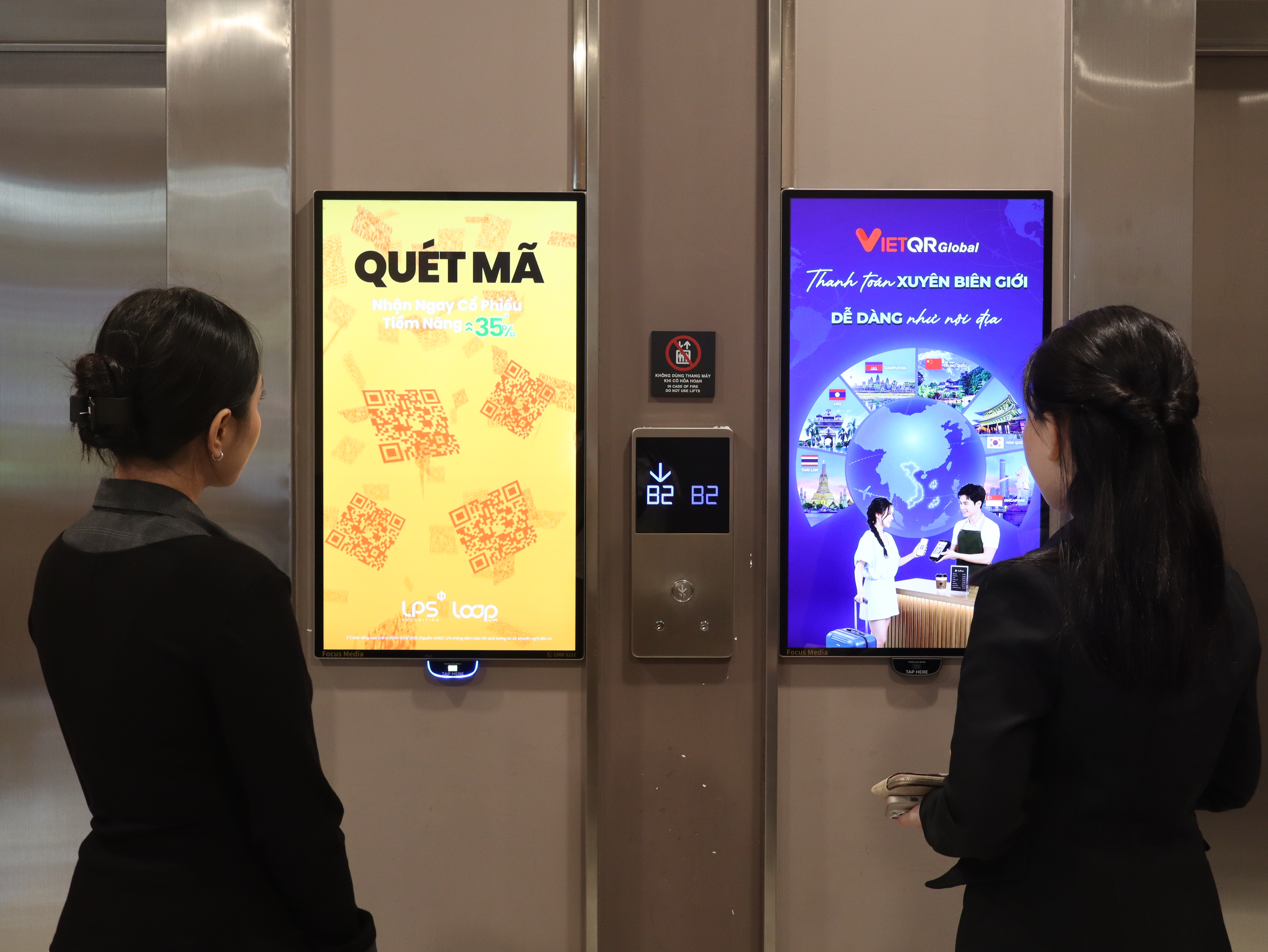
Today's users are bombarded with information, easily skimming through dozens of ads on their phones in just a few seconds. Faced with this reality, small, quiet spaces like lobbies or elevators emerge as prime locations to capture customer attention.
Taking advantage of this spatial potential, building advertising networks are demonstrating significant coverage. As of August 2026, the Focus Media Vietnam network alone comprises 657 office buildings with 4,997 advertising screens, primarily concentrated in major cities, with Ho Chi Minh City and Hanoi being two key markets.
During waiting periods and with minimal distractions, messages displayed on screens are easily visible to office workers. However, the value of this format lies not only in the number of screens, but also in strategic placement: choosing the right building category, the right area, and the right context to deliver the message to the right target audience.
Who can advertising in office buildings reach?
Advertising in office buildings primarily targets office workers, including staff, middle managers, business leaders, partners, and visitors. While digital advertising relies on algorithms to predict user needs and preferences based on browsing history and clicks, building advertising uses the space itself as a natural "filter." This format helps to group people with similar income levels, work environments, and schedules at a single touchpoint, allowing brands to reach their target audience without being dependent on online variables.
Because of this characteristic, two buildings located on the same street can offer different levels of accessibility. For example, a financial brand targeting high-level professionals will prioritize broadcasting points in Grade A office towers; while a food delivery app targeting young working professionals will optimize costs in Grade B and C building clusters. Therefore, an effective planning process must begin with defining the target customer profile, and then designing criteria for location, building classification, and the allocation of the appropriate number of screens.
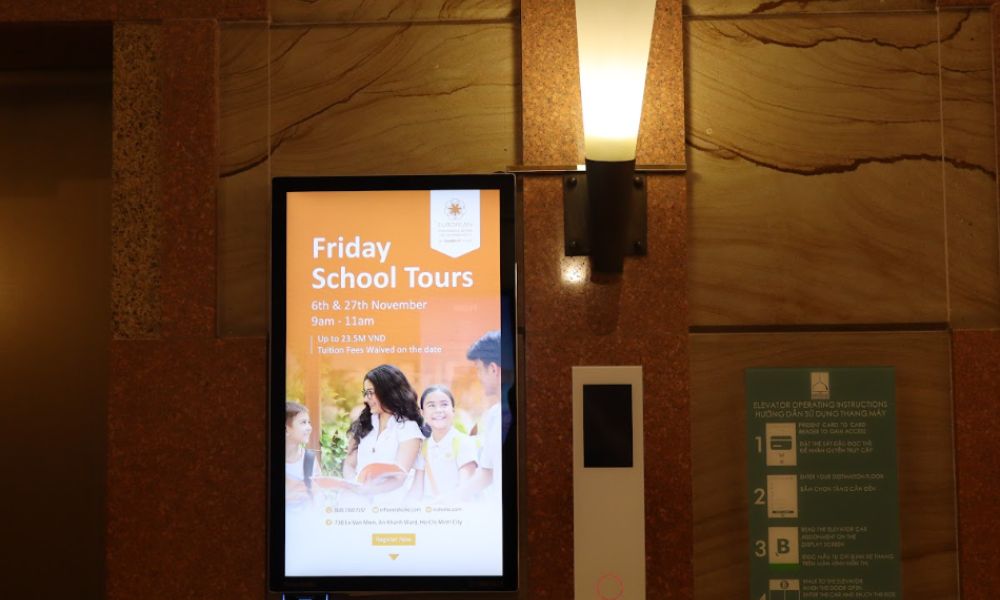
Effective outreach goes beyond simply choosing the right building class; it also stems from designing broadcast points along the viewer's movement path. Taking Focus Media as an example, the screens in Class A and B office towers are strategically placed in both the lobby and inside elevators. These two settings create distinct reception experiences: viewers have an open space to glance at the message while waiting for the elevator, then their attention is drawn to the enclosed space of the elevator cabin before they begin their work.
How many buildings and screens does Focus Media have in Ho Chi Minh City and Hanoi?
As of August 2026, Focus Media Vietnam owns a total of 18,489 screens distributed across 1,656 buildings nationwide, strongly concentrated in the two economic hubs, creating a massive display scale for campaigns:
- In Ho Chi Minh City: 875 buildings with 8,830 screens.
- In Hanoi: 738 buildings with 9,285 screens.
Simultaneously, Focus Media also maintains strategic broadcasting points in other major cities such as Da Nang (34 buildings, 276 screens) and Hai Phong (9 buildings, 98 screens), allowing brands to flexibly expand their reach as needed.
City | Number of buildings | Number of screens |
Hanoi | 738 | 9,285 |
Ho Chi Minh City | 875 | 8,830 |
Da Nang | 34 | 276 |
Hai Phong | 9 | 98 |
Total | 1,656 | 18,489 |
Some notable projects within Focus Media Vietnam's network include Vinhomes Central Park, Vinhomes Ocean Park, Vinhomes Smart City, Vinhomes Golden River, The Ascent Thao Dien (Ho Chi Minh City & Hanoi) , and The Ori Garden (Da Nang) . A complete list of broadcast locations by region can be provided upon request during the planning process.
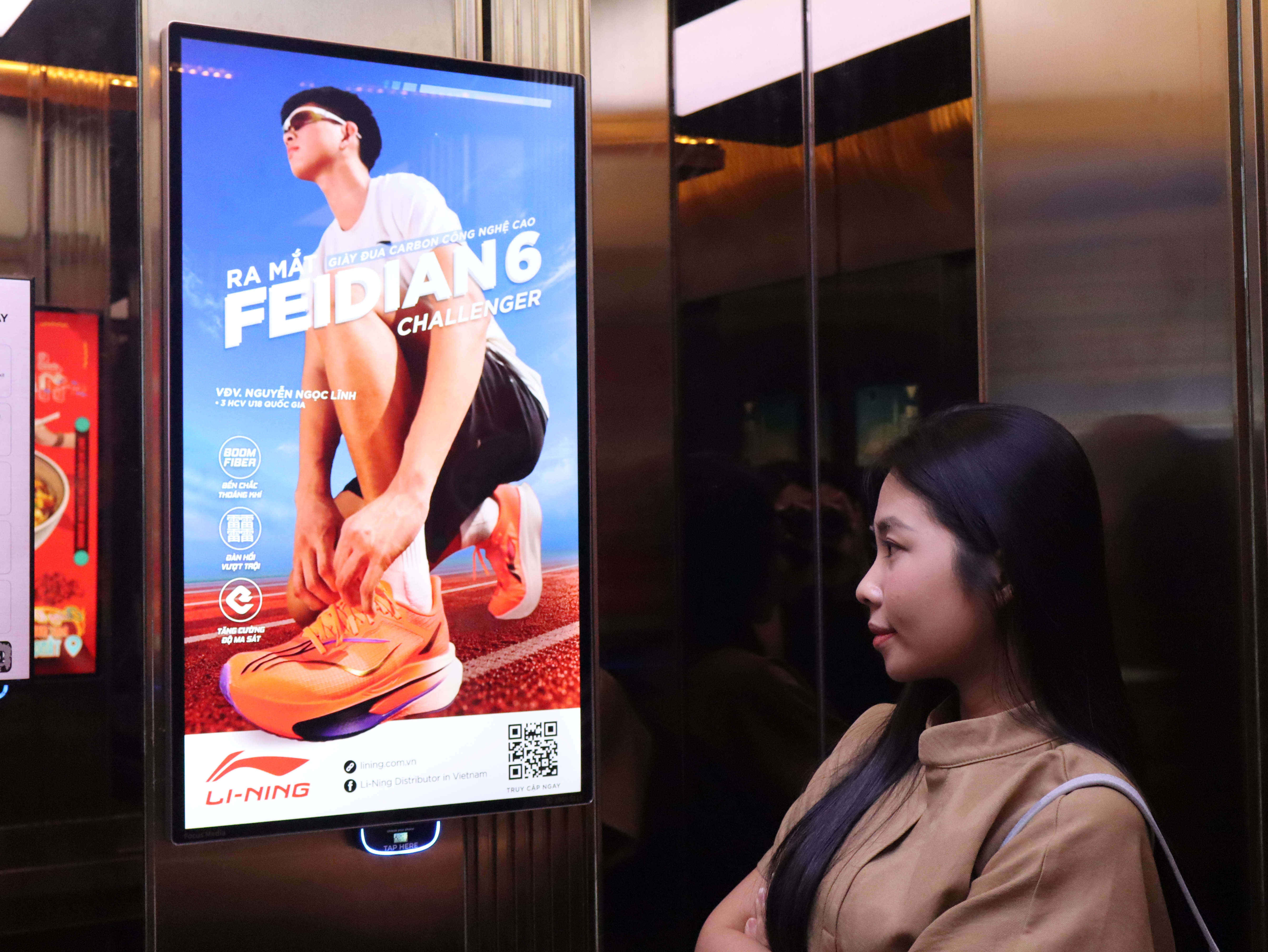
Notably, the office building group accounts for 657 locations with 4,997 screens across the entire system. Separating these two layers of data gives businesses a more accurate view when planning media campaigns, allowing brands to easily fine-tune distribution based on area, building category, and audience characteristics.
What opportunities for interaction are created by the rhythm of office life?
Traffic flow in office buildings is typically concentrated at three times: early morning, mid-lunch, and late evening. Unlike apartment buildings, where traffic is spread out into early mornings or late evenings, the workplace creates a very distinct cyclical pattern of travel.
An office worker might walk through the lobby, wait for the elevator, and move upstairs at the beginning of the day; at lunchtime, the same journey repeats as they leave the building and return, and this continues a third time when they finish their shift. Placing the screen directly on this mandatory movement axis allows the advertisement to be present repeatedly throughout the day in a natural way.
Data from NIQ, compiled by Focus Media, shows that the average waiting time is 198.8 seconds, while the travel time inside the elevator cabin is approximately 31.2 seconds. These two time points create two distinct contexts of interaction: the waiting area attracts attention while stationary, while the cabin continues the message during the journey.
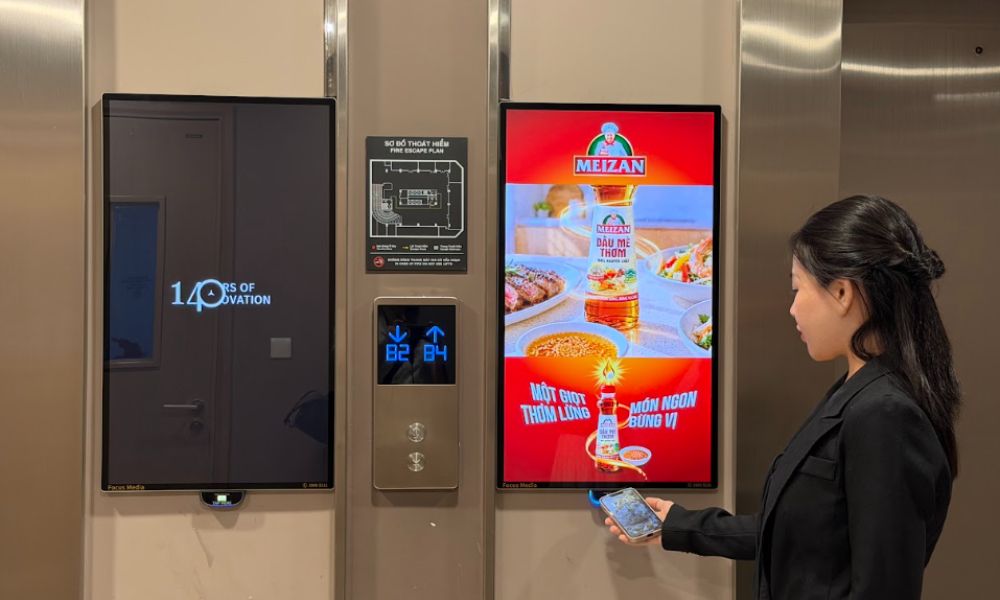
To optimize these touchpoints, brands can incorporate QR codes or NFC technology directly on the screen. Physical interaction (such as tapping the phone via NFC to access a landing page or Mini App) helps shorten the gap from awareness to actual action. Therefore, elevator advertising in office buildings not only increases brand awareness but can also serve subsequent conversion goals depending on how the business designs its content script.
When is it appropriate to combine office space and apartments in a building?
Office buildings and apartment complexes reach consumers in two different contexts throughout the day. While offices are associated with working hours and the rhythm of office life, apartments encompass the entire living and resting space. Therefore, elevator advertising display systems can help businesses reach many touchpoints in the consumer's daily journey.
For example, a marketing campaign might trigger awareness in the office during business hours and then continue to maintain reminders when consumers return home in the evening. Conversely, if the campaign's goals are focused on a specific group of employees in particular industries or business areas, allocating optimal budget to the appropriate office cluster will be more cost-effective than expanding broadly to residential areas.
Therefore, the choice between office or apartment space isn't about comparing which has more screens. The investment decision should stem from the target customer profile, their actual commute, and the specific role each environment plays within the overall campaign.


Comment (0)
Related News


 Contact
Let Focus Media Vietnam
Bring your brand into urban life
Share your campaign objectives. Focus Media Vietnam will advise on how your brand can appear at relevant touchpoints within the building and connect viewers to landing pages, e-commerce platforms, apps, or digital content.

No comments yet. Be the first to share your thoughts.