
 Tiếng Việt
 English
 中文
OOH/DOOH Industry Perspective
Elevator Advertising vs. Billboard Advertising: Which Should You Choose?
Last updated: 19 Nov 2026Elevator advertising reaches consumers in apartment buildings and office buildings, while billboards help brands appear on busy streets and in high-traffic areas. Each format differs in terms of target audience, display frequency, cost, and measurability. So which channel should businesses choose? This article will compare each criterion in detail, helping businesses determine the best option to suit their communication goals and budget.
1. What is the difference between elevator advertising and billboard advertising?
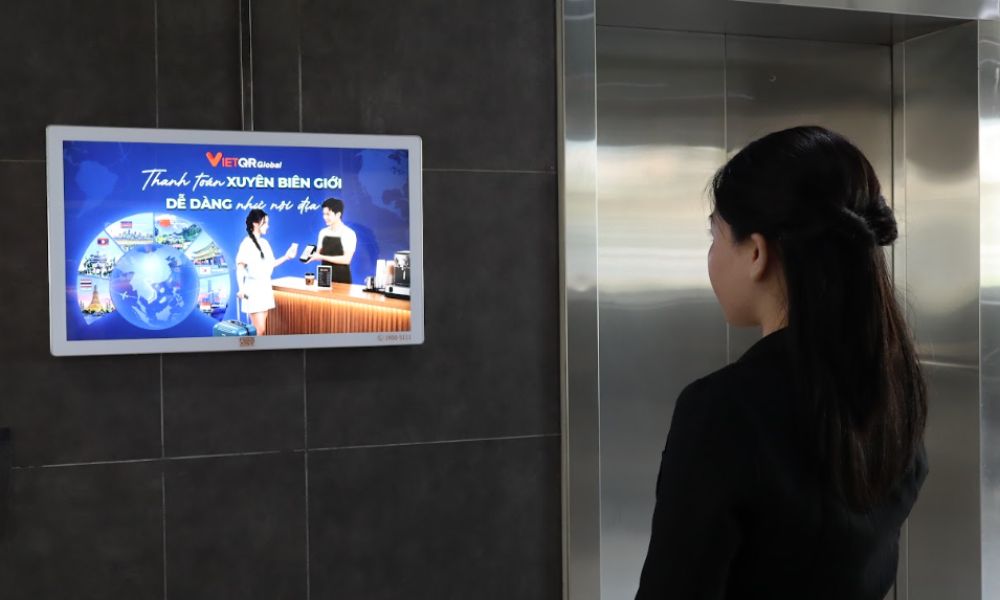
Elevator advertising is a form of place-based out-of-home (OOH) advertising that reaches consumers in the lobby or elevator cabin of apartment buildings and office buildings. Content is displayed in various formats, with LCD elevator TVs and digital frames belonging to the DOOH (Do-Oh!) advertising category. This form of advertising creates opportunities for interaction with building users during their daily activities and work.
Meanwhile, billboards are large-format advertising signs, typically placed along roads, at intersections, or in locations with wide visibility. Billboards can use static images or digital displays, targeting pedestrians and vehicles passing through the area where the billboard is placed. According to the OOH Advertising Association of America (OAAA), billboards are one of the main formats of out-of-home (OOH) advertising.

The core difference lies in the location and context of exposure: elevator advertising focuses on users of selected buildings, while billboards reach people traveling along specific routes. This difference affects the target audience, the likelihood of message repetition, and how businesses build their campaigns.
2. Comparing elevator advertising and billboards based on 7 criteria.
To choose the right advertising format, businesses need to consider not only the reach but also the target audience, frequency of appearance, cost, and measurability. The table below summarizes 7 criteria for comparing elevator advertising and billboards during the media planning process.
| Criteria | Elevator advertising | Outdoor Billboard |
| Display position | Lobby and elevator cabin in apartment buildings and office buildings. | Routes, intersections, and locations with expansive views. |
| Target audience | People who live, work, or regularly use the building. | People move past the area where the billboard is placed. |
| Reach | Depending on the area, the building clusters and screen networks are selected. | Based on the route, location, and number of billboards. |
| Frequency of exposure | There are opportunities for repeat elevator usage and broadcast schedules. | It depends on the number of times viewers pass by the location where the sign is placed. |
| Advertisement content | Images, TV commercials, or short videos on LCD and Digital Frame displays. | Still images or moving content on digital billboards. |
| Implementation costs | Depending on format, number of screens, region, duration, and broadcast schedule. | Depending on location, size, format, and rental period. |
| Measurability | Broadcast data, estimated reach, QR/NFC interaction when integrated. | Estimated traffic flow, visibility, and accessibility data. |
2.1. Differences in coverage and frequency of exposure
Billboards offer opportunities to reach people traveling along routes or intersections, with reach depending on placement, traffic volume, and visibility. Elevator advertising, on the other hand, reaches users of selected buildings, with the potential for repeated exposure during their daily activities and work.
However, frequency of appearance does not equate to the level of attention or recall of the advertisement . To assess reach and exposure effectiveness, businesses need to consider data on target audience, location, deployment time, and measurement methods for each format.
2.2. Differences in message delivery methods
Static billboards typically prioritize striking imagery, concise messages, and clear brand recognition so that passersby can quickly grasp the information. With digital billboards, content can change according to the broadcast schedule and the capabilities of the screen system.
Meanwhile, elevator advertising can utilize TV commercials, short videos, or product images on LCD screens and digital frames. Businesses need to adjust the layout, amount of information, and duration of content according to each format, instead of using the same design for every advertising location.
See also: Types of Elevator Advertising: Comparison & How to Choose
3. When should you choose elevator advertising, and when should you choose billboard advertising?
3.1. Choose elevator advertising when you need to reach customers by area.
Elevator advertising is suitable for campaigns that want to focus on apartment complexes or office buildings with customer characteristics similar to the product. Businesses can choose the area, building group, and number of screens according to the network's capacity.
For example, a consumer goods brand might consider apartment complexes suitable for families. Meanwhile, a product or service aimed at working professionals might prioritize office buildings in the target area.
3.2. Choose Billboard when you need to create a presence on a key route.
Billboards are a worthwhile consideration for brand building campaigns along key routes or intersections. This format is suitable when businesses want to maintain a presence in a specific location and convey a message that is easily recognizable from a distance.
The effectiveness of a billboard depends on its location, visibility, speed of movement, and advertising design. Therefore, the choice should not be based solely on traffic volume, but also on the actual visibility of each location.

3.3. Selection based on communication objectives
| Target | The form should be considered. |
| Increase brand presence on key routes. | Billboard |
| Reaching out to residents in apartment complexes. | Elevator advertising |
| Reach out to people who work in office buildings. | Elevator advertising |
| Expand the touchpoints between traffic and buildings. | Combine two channels |
| Create online interaction at the advertising point. | Elevator screens with compatible QR/NFC |
These options are guidelines. Businesses still need to consider customer data, location lists, costs, and evaluation methods to develop a suitable plan.
4. Comparing the cost and effectiveness of elevator advertising with billboards.
It's impossible to conclude that elevator advertising is cheaper than billboard advertising, or vice versa, without first determining the scope of implementation. The two forms of advertising have different pricing structures, so comparing individual prices can easily lead to inaccurate conclusions.
The cost of elevator advertising depends on the format, area, number of exposure points, content duration, and broadcast frequency. For billboards, the budget is typically related to location, billboard size, rental period, and production, construction, or operational costs.
What metrics need to be measured?
When comparing performance, businesses should consider three groups of data:
- Advertising distribution: List of locations, broadcast schedule, deployment time, and proof of acceptance.
- Reach: Estimated impressions or exposure opportunities, coverage, and frequency as measured using appropriate methods.
- Campaign results: Brand awareness, ad recall, engagement, or conversions (if research and tracking data are available).
In this context, CPM (Cost Per Mille) represents the cost per 1,000 impressions:
CPM = (Total cost / Total impressions) × 1,000
CPM should only be used for comparison when the two options have sufficiently similar methods for determining impressions. The number of plays on screen does not automatically equal the number of views; traffic passing by a billboard does not prove that all passersby noticed the advertisement.
See also: Measuring DOOH Advertising: Metrics and Evaluation Methods
5. Should elevator advertising and billboard advertising be combined?
Yes, if the campaign needs to maintain brand presence at multiple stages of the customer journey. For example, when launching a new product in Ho Chi Minh City, a business could use billboards on key routes to showcase the main visual identity, combined with elevator screens to convey additional product information or calls to action.
However, the two channels need separate roles and budgets, rather than simply increasing the number of ad placements. Businesses should agree on the messaging, implementation timeline, and performance metrics from the outset to determine each channel's contribution within the scope of measurable data.
6. Elevator advertising solutions at Focus Media Vietnam
With its extensive network across urban areas, Focus Media Vietnam offers elevator advertising solutions that help businesses increase their brand presence at everyday touchpoints.
According to data released on November 1, 2026, Focus Media owns 19,434 screens at 2,174 locations , with an estimated 463.6 million impressions and 22.08 million reach per month, according to LifeSight data from October 2026.

In addition to LCD Elevator TV and Digital Frame systems, Focus Media combines remote content management technology, data-driven planning support, and NFC interactive solutions to enhance campaign deployment and tracking. Contact Focus Media for advice on advertising solutions tailored to your communication goals and budget.
Here are some case studies of elevator marketing implementation at Focus Media:
- What do elevator advertisements help viewers remember about Nanfu alkaline batteries?
- Want Want Frozen: 78% of those surveyed intend to buy after 8 weeks of elevator advertising.
7. Frequently Asked Questions
7.1. Should you choose elevator LCD advertising or outdoor billboards?
An elevator LCD screen is a good choice if you want to reach customers in apartment buildings and offices and convey messages through short videos. Billboards are more suitable when businesses need to create a brand presence on key routes. The decision depends on your goals, target audience, and budget.
7.2. Is elevator advertising really effective?
Yes, if you choose the right building and target customer group. For example, a brand targeting young families might prioritize apartments, while a service for office workers might choose office buildings.
7.3. Is the cost of advertising on LCD screens inside buildings lower than billboards?
There's no single correct answer. LCD costs depend on the number of screens, area, and broadcast schedule, while billboard costs depend heavily on location, size, and rental duration. Businesses need to compare quotes for the same scope and deployment timeframe.
7.4. Should elevator advertising and billboard advertising be combined?
Yes, when businesses need to increase brand awareness at multiple touchpoints, billboards can serve as the primary visual element on the streets, while elevator screens can supplement the message in target buildings.
7.5. Which companies provide elevator advertising services in Vietnam?
Focus Media Vietnam is one of the leading providers of elevator advertising with LCD Elevator TV and Digital Frame systems. Businesses can choose solutions based on location, format, and campaign objectives through Focus Media's advertising network.
Elevator advertising and billboards both have their own advantages, depending on the communication goals and the target audience the business wants to reach. Choosing the right option not only optimizes the budget but also enhances campaign effectiveness. If your business is looking for elevator advertising solutions, consider... Contact Focus Media Vietnam or call 1900 5111 for advice on the most suitable implementation plan.
See more:


Comment (0)
Related News



 CONTACT
CONNECT WITH FOCUS MEDIA VIETNAM
Share your campaign goals. Focus Media Vietnam will advise on how your brand can appear at the right touchpoints within the building and connect viewers to your landing page, e-commerce platform, app, or digital content.

No comments yet. Be the first to share your thoughts.