
 Tiếng Việt
 English
 中文
中文

Media guide
Building a DOOH + Digital Scenario for a New Product Launch
Last updated: 16 Apr 2026As customer acquisition costs on digital platforms continue to rise, combining DOOH with Digital Ads has become one of the most effective strategies for optimizing ROI in new product launch campaigns.
This article breaks down a sharp three-stage communications scenario, showing how businesses can combine the brand-building reach of an Elevator Media Advertising network with the flexible conversion capabilities of Digital to create a powerful O2O conversion funnel.
Why Is Digital Advertising Alone No Longer Enough?
When launching a new product, the ultimate objective is to capture Top of Mind among the Target Audience as quickly as possible.
However, if a brand relies solely on Digital, it can easily become lost among the millions of ads displayed every day due to Banner Blindness.
Conversely, if a brand relies only on traditional outdoor advertising, it lacks the tools needed to measure effectiveness and drive immediate action through a Call-to-Action.
This is where the “DOOH + Digital” scenario demonstrates the value of a closed-loop ecosystem.
According to advertising effectiveness measurement reports from NielsenIQ (NIQ) in collaboration with Focus Media, campaigns that combine DOOH with search engines and social media can generate Search Lift — an increase in organic search volume — of up to 40–60%.
DOOH acts as a physical visual anchor in the real world, building Trust and strong Brand Awareness. Digital Ads, meanwhile, act as the “net” that captures search demand and converts it into Conversion.
A Detailed 3-Stage DOOH + Digital Scenario for Persuading Customers
To make the scenario easier to visualize, consider a B2B technology company or premium real estate brand launching a new product.
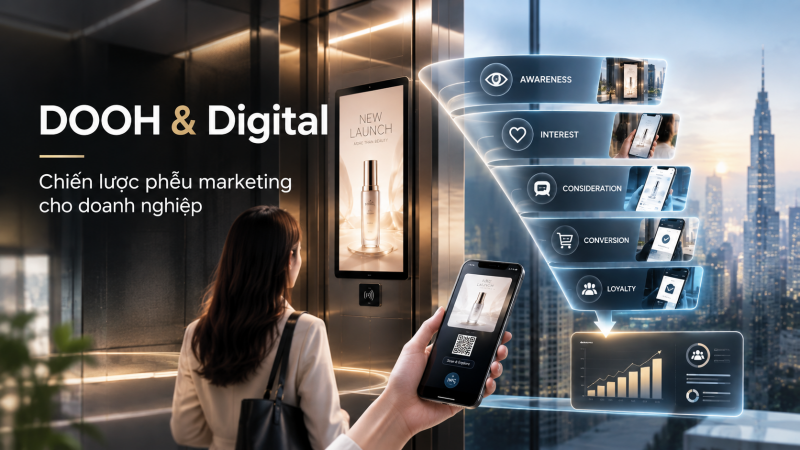
Below is a customer journey funnel designed by Focus Media Vietnam specialists.
Stage 1 (Awareness): Cover the Audience’s Daily Life Trajectory
The first stage of a product launch is about educating the market and building familiarity. Few channels are better suited to this role than Elevator Media Advertising.
Deployment strategy: The brand selects a network of Grade A office buildings and premium residential developments where the right Target Audience is concentrated. A 15–30 second TVC is repeatedly displayed on LCD/Frame screens.
Psychological effect: In the enclosed elevator environment, users spend approximately 30–60 seconds waiting or traveling. They are less distracted by smartphones — as mobile signals may often be weaker inside elevators — or by traffic. Seeing a sharp DOOH advertisement repeatedly 4–6 times per day while commuting, going to lunch, or returning home naturally reinforces the message in memory.
Measurement KPIs: At this stage, the key metrics are Reach, Frequency, and VAC (Visually Adjusted Contact).
Expert Tip: In Stage 1, DOOH creative should contain a powerful Hook. Use a short message, large typography, distinctive brand colors, and a unique keyword to stimulate curiosity. Do not push the customer to buy immediately — make them remember the product name first.
Stage 2 (Consideration): Capture Demand on Google and Social Media
This is where the O2O (Offline-to-Online) process becomes most powerful.
The curiosity created in Stage 1 now begins to translate into search behavior.
Customer behavior: After leaving the elevator or returning to their desk, target customers who were impressed by the DOOH creative may take out their phone or open a browser to search for more information about the brand or new product.
Digital support strategy: At this moment, the Digital campaign needs to be running at maximum volume.
SEM (Google Ads/Search Engine Marketing): Immediately bid on brand keywords and the exact keywords displayed on the DOOH screens. When users search, the brand’s website should appear at the top of the results.
Social Ads (Facebook, LinkedIn, TikTok): Use Geo-fencing to target users within approximately a 1 km radius of the same office buildings where the DOOH campaign is running. Customers experience a highly synchronized journey: “I saw this ad in the elevator this morning, and now I’m seeing a detailed product report on LinkedIn.”
Behavioral psychology: This cross-channel repetition creates a Halo Effect and the perception that the brand is highly visible across multiple environments, reinforcing credibility and increasing the click-through rate (CTR) of Digital Ads.
Stage 3 (Conversion): Close the Sale Through Retargeting
Once customers click on a Digital Ad or visit the Landing Page to learn more, they officially enter the Hot Leads audience pool.
Deployment strategy: Display Ads and Email Marketing now take the lead. Retargeting campaigns are activated with stronger action-oriented messages such as “Book a Test Drive,” “Request a Quotation,” or “Exclusive Offer for the First 100 Registrations.”
Cross-channel ROI measurement: Analytics tools track the final conversion journey. Although the actual Conversion takes place in the Digital environment, data-driven Attribution Models used by experienced agencies can recognize the significant Assisted Conversion role played by the original DOOH campaign.
Why Choose Focus Media Vietnam?
A theoretical scenario can look perfect, but successfully executing an Omnichannel campaign depends heavily on the capabilities of the DOOH platform provider — particularly its Authoritativeness and Trustworthiness.
Reach the Right Audience with Precision Targeting
You cannot always use Facebook Ads to target “every resident of Landmark 81” with absolute precision. Focus Media, however, can help brands achieve comprehensive DOOH coverage across Elevator Media clusters in that location, helping ensure that the Core Audience is repeatedly exposed to the message.Synchronize Data and Timing with Real-Time Sync
Through Focus Media’s global cloud-computing platform, campaign ordering and advertising delivery are managed in real time. Media Planners can align DOOH delivery schedules with periods of increased SEM bidding budgets — for example, concentrating activity between 8–9 a.m. and 5–6 p.m. — creating stronger cross-channel impact.Effectiveness Measurement Supported by NIQ
Focus Media provides performance reports developed in collaboration with NIQ, helping brands evaluate the contribution of DOOH to overall growth in Brand Awareness and Purchase Intent during launch campaigns.
Omnichannel Strategy Summary
| Stage | Primary Tools | Core Objective | Role of the Channel |
|---|---|---|---|
| Awareness | Elevator Media Advertising | Build awareness and curiosity | Physical visual anchor that creates Reach and repeated Frequency in a captive environment |
| Consideration | SEM, Social Ads (Geo-fencing) | Convert curiosity into website traffic | Capture Search Lift generated by DOOH and increase CTR |
| Conversion | Retargeting, Email | Close the funnel and generate Leads/Sales | Overcome final purchase barriers using previously engaged audience data |
Launching a new product always comes with risk and growth pressure. However, by combining the credible, difficult-to-ignore visibility of DOOH with the flexible sales-closing capabilities of Digital, brands can build a highly effective communications strategy that optimizes every touchpoint along the customer decision journey.


Comment (0)
Related News



 Contact
Let Focus Media Vietnam
Bring your brand into urban life
Share your campaign objectives. Focus Media Vietnam will advise on how your brand can appear at relevant touchpoints within the building and connect viewers to landing pages, e-commerce platforms, apps, or digital content.

No comments yet. Be the first to share your thoughts.