
 Tiếng Việt
 English
 中文
LCD or Digital Frame: Which Screen Should You Choose for Your Campaign?
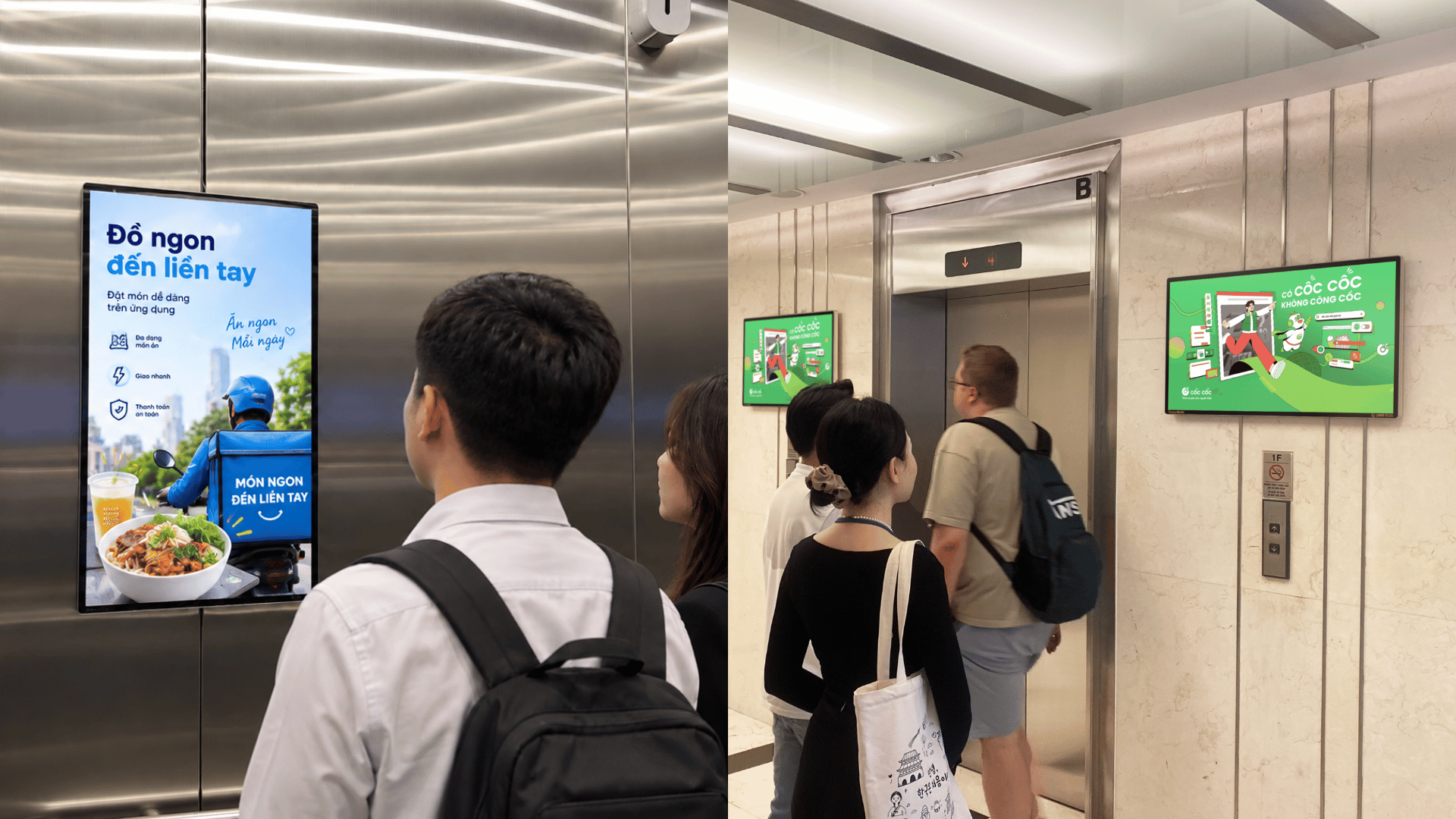
Last updated: 16 Nov 2026LCD screens are typically placed in lobbies or common areas, suitable for dynamic content such as TV commercials and short promotional videos. Digital frames, on the other hand, are installed in elevator cabins and are ideal for product images, key visuals, and concise messages to increase brand awareness. The choice between LCD and digital frames depends on the communication objectives, target audience, and content format of the campaign.
1. Two formats, two different locations
Both LCD and Digital Frame are digital advertising displays used in elevator communication systems. However, the two formats differ in terms of installation location, content display, and communication objectives.
Criteria | Digital Frame (in the cabin) | LCD (in the lobby) |
|---|---|---|
Installation location | Inside the elevator cabin | Lobby, hallway, common areas |
Contact time | Short, while moving between floors | Longer, while waiting for the elevator |
Appropriate content formatting | Short video, motion, concise message. | Static images offer a more detailed layout, making them easier to read at longer intervals. |
Frequency of repetition | Very high, per movement | High, according to the number of people passing through the common area. |
Suitable for the purpose | Quick memorization, brand recognition | Conveying information that requires careful reading, product images. |
Businesses can learn more about the characteristics and implementation of each format through the following articles:
- LCD advertising in elevators: Costs and implementation.
- Elevator frame advertising: Features, costs, and implementation.
2. When should both be used?
A campaign aiming to expand touchpoints along the commute of residents or office workers could combine both formats: LCD screens in the lobby conveying the message via TV commercials, while digital frames in the cabin reinforce product imagery and brand awareness.
However, not every campaign needs to use both types of screens simultaneously. With a limited elevator advertising budget , businesses should prioritize the format that best suits their main goals and target audience, rather than spreading the budget too thinly.
3. Should the content be static or dynamic?
With LCD screens, dynamic content such as TV commercials or short advertising videos is suitable for showcasing product features and conveying messages through moving images. Creatives should have a clear focal point, helping viewers grasp the information even without watching the entire video.
Digital frames, on the other hand, feature high-quality static images, clear layouts, and concise messaging, making them suitable for highlighting products, logos, or promotions. While moving content can be used depending on screen configuration, businesses should prioritize easily recognizable designs for short viewing times.
4. LCD and Digital Frame Advertising Solutions at Focus Media Vietnam
Focus Media Vietnam provides elevator media solutions with two main formats: LCD Elevator TV in the lobby and Digital Frame inside the cabin. Businesses can choose each format individually or combine both to reach consumers in apartment buildings, office buildings, and commercial locations.
According to data released in October 2026, Focus Media owns a network of over 19,000 screens in over 2,000 locations , with an estimated more than 463.6 million impressions and 22.08 million reach per month . These are network figures, not just LCD or Digital Frame data.
Depending on your communication goals, target audience, and budget, Focus Media advises on the appropriate format, location, and number of screens. Contact Focus Media or call 1900 5111 for advice on elevator advertising solutions.
5. Frequently Asked Questions
Are the content production costs different for the two formats?
Yes. Video content for LCDs typically requires additional editing, motion capture, and post-production. Digital frames, on the other hand, can utilize key visuals or still images, reducing production volume if the business already has a suitable design.
Is it mandatory for a campaign to use both?
No. Businesses should choose LCD, Digital Frame, or a combination of both based on their communication goals, target audience, and budget, rather than defaulting to using as many formats as possible.
Can the content be used in both formats?
The main idea and message can be shared. However, the aspect ratio, layout, and duration need to be adjusted according to the technical requirements of each screen type to ensure the content is displayed appropriately.
Therefore, the choice between LCD and Digital Frame depends on the communication goals, content format, and customer reach. LCD is suitable for TV commercials and moving content in lobbies, while Digital Frame helps increase brand awareness and recall in elevator cabins. Businesses can contact Focus Media or call 1900 51 11 for advice on the solution best suited to their campaign.


Comment (0)
Related News






 Contact
Let Focus Media Vietnam
Bring your brand into urban life
Share your campaign objectives. Focus Media Vietnam will advise on how your brand can appear at relevant touchpoints within the building and connect viewers to landing pages, e-commerce platforms, apps, or digital content.

No comments yet. Be the first to share your thoughts.