
 Tiếng Việt
 English
 中文
What is OOH? Types, advantages, disadvantages, and implementation methods.
Last updated: 16 Nov 2026OOH (Out-of-Home) advertising is a form of advertising that reaches consumers outside their private living spaces, appearing on streets, transportation, buildings, shopping malls, and many other public places. Not limited to traditional billboards, OOH advertising today also includes digital screens. This article will help businesses understand what OOH is, its common forms, benefits, and how to choose the right one for their communication campaign.
1. What is OOH? What does OOH stand for?
OOH (Out-of-Home Advertising) is a form of advertising that reaches consumers outside their homes, through media outlets in the places where they commute, work, shop, or entertain.
In Vietnam, OOH is often referred to as outdoor advertising . However, the scope of OOH is broader than billboards placed on the streets, encompassing advertising at train stations, airports, shopping malls, office buildings, and elevators.
According to the OOH Advertising Association of America (OAAA) , OOH is divided into four main categories: Billboard, Street Furniture, Transit, and Place-based OOH. These forms can utilize static advertising surfaces or digital screens.
Are OOH and DOOH the same thing?
DOOH (Digital Out-of-Home) is digital outdoor advertising that uses electronic screens to display content. Compared to static OOH advertising such as billboards or printed posters, DOOH allows for changes to advertising content according to a schedule and remote updates depending on the operating system.
Therefore, DOOH is part of OOH , not a completely separate advertising channel. The main difference lies in the display technology and content management capabilities, while both reach consumers in locations outside of their homes.
2. Popular forms of OOH advertising today
OOH advertising takes many different forms of implementation, depending on the location, how the content is displayed, and the context in which consumers interact with it.
According to the OAAA classification system, OOH is divided into four main groups:
OOH form | Popular locations | Characteristic |
Billboard | Main road, highway, building facade | Large advertising surfaces, often visible from a distance. |
Street Furniture | Bus shelters, kiosks, public amenities | Approach pedestrians or road users at close range. |
Transit Advertising | Bus, taxi, train, train station, airport | Reaching consumers along their journey |
Place-based OOH | Apartments, offices, shopping malls, movie theaters | Reaching consumers in locations with specific usage contexts. |
2.1. Billboard and Pano advertising
Billboards are a form of advertising that utilizes large display surfaces on streets, highways, intersections, or building facades. Common formats include traditional billboards and outdoor LED screens.
This approach is suitable for campaigns to increase brand presence in a specific geographic area. When implementing it, businesses need to pay attention to the vision, traffic flow, and design a concise and easily recognizable message.
2.2. Advertising in public amenities (Street Furniture)
Street furniture refers to advertising placed in public amenities such as bus shelters, information kiosks, or billboards intended for pedestrians.
With its proximity to pedestrian traffic, this format is suitable for increasing brand presence on streets, in residential areas, and in commercial districts. Reach depends on the installation location and foot traffic.
2.3. Transit Advertising
Buses, taxis, and trains not only serve transportation needs but also act as a means of conveying brand messages. Advertising can appear on the vehicle's exterior, inside the vehicle, or in station areas.
Key considerations when implementing Transit Advertising include the operating route, operating hours, and passenger characteristics. These factors determine the suitability of advertising placement for the target audience.
2.4. Place-based OOH advertising
Unlike groups associated with transportation, place-based OOH focuses on living, working, and shopping spaces such as apartments, office buildings, shopping malls, and supermarkets.
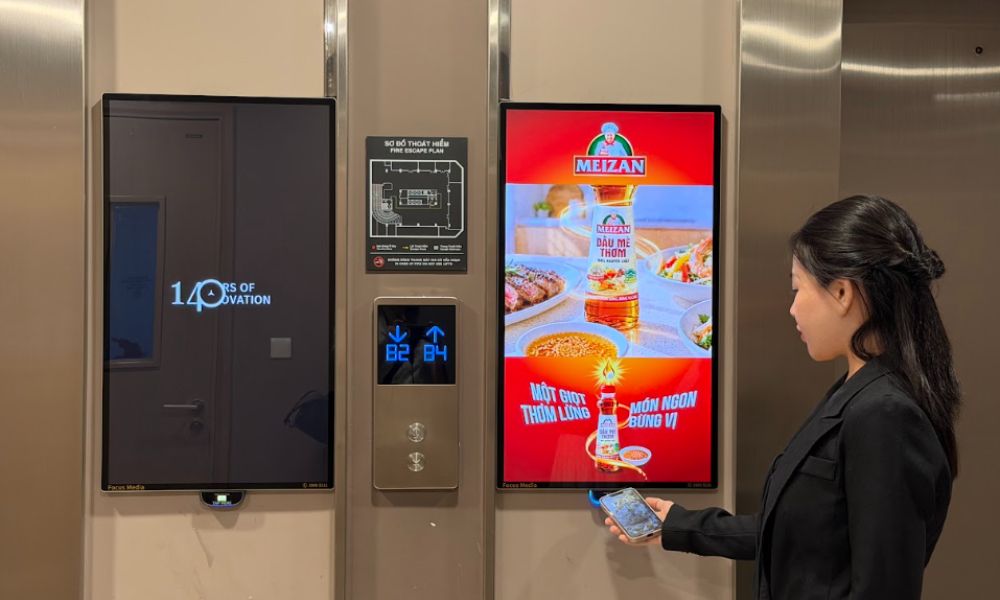
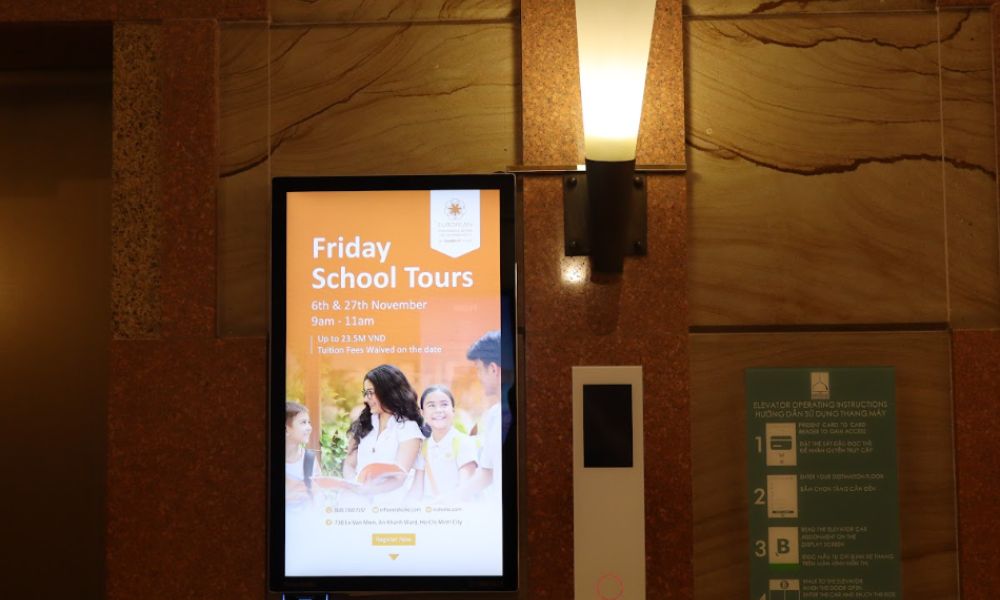
For example, elevator advertising creates opportunities to interact with residents and office workers during their commute within the building. The advantage of this type of advertising lies in its ability to select locations based on the context of the interaction and the characteristics of the target audience.
Note: All four OOH groups can use either static or digital formats. DOOH refers to OOH advertising that uses digital screens, not the fifth location group.
See more:
- Elevator Advertising Options: Comparison & How to Choose
- Elevator Advertising Price List 2026: LCD & Digital Frame
3. Advantages and disadvantages of OOH advertising
OOH advertising helps brands appear in locations where consumers frequently travel, live, and work. However, the effectiveness of reach depends on the location, the way the message is presented, and the measurement methods of each format.
Advantage:
- Increased brand awareness: Advertisements appearing on streets, in residential areas, and in commercial locations help brands expand their presence.
- Create opportunities for repeated exposure: People who frequently travel along the same route or visit the same location may encounter the message multiple times.
- Diverse deployment options: Businesses can choose billboards, traffic advertising, or digital screens depending on their objectives.
- Multi-channel communication support: OOH can be combined with online advertising to expand touchpoints in the customer journey.
Disadvantages:
- Location-dependent advertising: Visibility, direction of movement, and obstacles affect the ability to see the advertisement.
- It's difficult to pinpoint the exact audience: Foot traffic doesn't necessarily mean the number of people who actually see the advertisement.
- Implementation costs vary: Budgets depend on location, format, scale, and timeframe.
- Direct conversion measurement is difficult: It requires a combination of outreach data, surveys, or other appropriate measurement methods to assess the impact.
4. Which type of OOH advertising should businesses choose?
Choosing OOH advertising should start with communication goals and customer characteristics, rather than simply prioritizing high-traffic locations. Each format has its own advantages in terms of reach, viewing time, and content delivery.
Campaign objectives | OOH (Out-of-Home) marketing should be considered. | Selection criteria |
Increase brand presence across a wider audience. | Billboards, banners, outdoor LED displays | Vision, route, remote identification capabilities |
Reaching customers during their journey | Advertising on buses, taxis, and train stations. | Route, passenger group, contact time |
Promote products near shopping areas. | Shopping mall screens, point-of-sale advertising. | Location, shopping behavior, product category |
Reaching residents and office workers | Elevator and building advertising screens | Type of building, area, user characteristics |
Change content periodically or according to campaigns. | DOOH has a content management system. | Release schedule, creative formats, and update capabilities. |
Besides placement, the design of the message also determines the effectiveness of advertising . Businesses should take note of the following:
- Prioritize one main message: Avoid including too much text or information that makes it difficult for the viewer to grasp.
- Design according to viewing context: Billboards need to be easily readable from a distance, while screens in the waiting area can display more detailed content.
- Check display quality: Image, contrast, font size, and playback duration need to match the actual viewing location.
- Combine appropriate calls to action: QR codes or NFC tags can be used in locations where viewers are able to interact safely.
For example, for a product launch campaign targeting office workers, a brand might consider screens in elevator lobbies, using prominent product images and a short message. Conversely, if a presence needs to be established on major transportation routes, a billboard with a minimalist design would be more appropriate.
5. What factors influence the cost of OOH advertising?
The cost of OOH advertising varies depending on the format and implementation conditions. Billboards and banners are usually priced based on location and rental time, while DOOH advertising may be based on the number of screens, duration, and frequency of the advertisement.
The main factors include:
- Ad placement: Area, visibility, traffic, and characteristics of the audience.
- Types and specifications: Billboards, banners, LED or LCD displays each have their own pricing methods and technical requirements.
- Campaign scale: Number of locations, screens, and deployment areas.
- Display time: Rental period, broadcast schedule, and advertising frequency.
- Additional costs: Design, manufacturing, construction, operation, or acceptance testing, depending on the form.
When receiving quotes, businesses should check the unit of measurement, list of locations, display time, and what is or is not included . Cost comparisons should be based on comparable deployment scopes, rather than just looking at the total budget.
6. How is the effectiveness of OOH advertising measured?
The effectiveness of OOH advertising is evaluated across three aspects: deployment level, reach, and impact on consumers. Depending on the advertising format, businesses can utilize different data sources and measurement methods.
First, it's necessary to check if the advertisement is being implemented according to plan. For static OOH, the verification data includes location, installation images, and display time. For DOOH, additional monitoring includes broadcast logs, number of broadcasts, and advertisement duration.
Next, we assess accessibility through common indicators:
Index | Meaning |
OTS | Number of potential exposure opportunities to advertising. |
Impressions | Estimated advertising exposures |
Reach | The number of people who were seen by the advertisement varied. |
frequency | Average frequency of contact per person |
CPM | Estimated cost per 1,000 impressions or exposures |
Finally, the impact of the campaign can be assessed through brand awareness surveys, search volume, website traffic, or QR/NFC interactions if implemented.
See also: Measuring DOOH advertising: Metrics and evaluation methods
7. Process for implementing OOH advertising campaigns
To implement effective OOH advertising, businesses need a clear plan from location selection and content design to results monitoring. The process typically consists of five steps:
- Define goals and customers: Clarify objectives such as increasing awareness, promoting products, or supporting sales; identify the areas and customer groups to reach.
- Choose your advertising format and location: Survey billboards, transportation vehicles, or digital screens based on your target audience, visibility, and budget.
- Content design and review: Create concise and easily recognizable messages; check the size, format, and content requirements of advertisements before deployment.
- Booking and campaign deployment: Confirm location, time, cost, and conditions; proceed with installing static ads or setting up a broadcast schedule for DOOH.
- Effectiveness review and evaluation: Check if the ads are displayed as planned, compare reach data, and summarize results to learn from the experience for the next campaign.
In practice, businesses should survey locations and test display content before officially launching , especially for campaigns with multiple locations or using different OOH formats simultaneously.
8. Examples of real-world OOH advertising campaigns
8.1. Prudential – OOH Campaign “Together We Preserve What Is Precious”
In August 2026, Prudential will launch outdoor LED advertising in Hanoi, Da Nang, and Ho Chi Minh City , combining check-in activities, minigames, and digital interaction. A highlight will be the experience of creating AI-powered greetings on billboards at Caravelle Saigon.
According to the YouNet Media Index in August 2026, Prudential's media activities recorded 1.8 million video views , implemented 4 minigames , and ranked 5th in the insurance industry brand ranking .
This is the overall media result and does not reflect the reach or effectiveness of OOH screens alone. The campaign demonstrates how the brand combined outdoor advertising with online engagement to extend the customer journey.
8.2. Nanfu – Elevator advertising campaign with Focus Media
To increase brand awareness of alkaline batteries in Vietnam, Nanfu is implementing a TV commercial on Focus Media Vietnam 's LCD screens and Digital Frames in 18 apartment and office buildings in Hanoi and Ho Chi Minh City.
The advertisement uses images of Kungfu pandas and a message about the product's durability, making it easily recognizable to viewers within a short viewing time.
According to a survey conducted by NielsenIQ for Focus Media in February 2026 , based on a sample of 300 people in two cities:
- 73% of respondents remember the advertisement.
- 86% of the 182 people surveyed correctly identified the Nanfu brand through the visual advertisement.
- 83% of those surveyed said they intended to buy the product after watching the TV commercial.
These results reflect the level of recall and purchase intention within the survey scope, not the actual purchase rate.
This campaign illustrates how place-based OOH leverages touchpoints within buildings to deliver product messages and measure responses from the target customer group.
See details: What does the elevator advertisement help viewers remember about Nanfu alkaline batteries?
9. Frequently Asked Questions about OOH Advertising
9.1. Which industries are suitable for OOH advertising?
OOH (Out-of-Home) advertising is suitable for many industries such as FMCG, real estate, finance, retail, technology, and services. Businesses need to choose the advertising format and location based on customer characteristics and communication goals.
9.2. Should small businesses implement OOH advertising?
Yes. Small businesses can focus on specific locations or areas that align with their target customer base instead of expanding widely. Budgets and booking requirements vary depending on the specific model and provider.
9.3. Can OOH advertising target the right customers?
Target audiences can be selected based on geographic location, type of location, and characteristics of people who frequently visit those locations. However, OOH advertising cannot precisely target individuals like some other forms of online advertising.
9.4. How long should an OOH advertising campaign last?
The deployment time depends on the objectives, budget, and desired frequency of exposure. Businesses should choose a duration that suits their communication plan and location rental conditions.
9.5. Can OOH advertising be combined with Digital Marketing?
Yes. OOH helps brands establish a presence in physical locations, while digital marketing supports interaction and reach on digital platforms. Combining the two channels can expand touchpoints and support customers in their product exploration process.
OOH advertising helps brands be present in places where consumers live, work, and commute daily. Choosing the right format should be based on communication goals, customer characteristics, and budget, rather than just considering the size of the billboard. Businesses interested in elevator advertising solutions in buildings should contact Focus Media or call 1900 5111 for detailed advice.
See more:


Comment (0)
Related News



 Contact
Let Focus Media Vietnam
Bring your brand into urban life
Share your campaign objectives. Focus Media Vietnam will advise on how your brand can appear at relevant touchpoints within the building and connect viewers to landing pages, e-commerce platforms, apps, or digital content.

No comments yet. Be the first to share your thoughts.