
 Tiếng Việt
 English
 中文
Media Handbook
What is Brand Awareness? Its Role and How to Build Brand Awareness
Last updated: 25 Nov 2026Brand awareness refers to the degree to which consumers recognize and remember a brand. However, frequent exposure to customers does not automatically guarantee brand memorability or preference. So, what should businesses do to enhance brand awareness and measure the effectiveness of their brand awareness building activities? Let's explore this in detail in the following article!
1. What is brand awareness?
Brand awareness is the degree to which consumers can recognize and remember a brand within a specific industry. This awareness is developed through exposure to the name, logo, colors, marketing messages, and actual experiences with the product or service.
In marketing, brand awareness is typically evaluated at three levels:
- Brand Recognition: Customers can recognize a brand when provided with identifying signs. For example, upon seeing the bitten apple logo, consumers can recognize Apple without having to read the brand name.
- Brand Recall: Customers may spontaneously recall a brand when a product category is mentioned without needing prompting. For example, when asked about beverage brands, customers might proactively mention Coca-Cola or Pepsi.
- Top of Mind: The first brand that comes to mind for customers when a particular product category is mentioned. For example, Honda is the first name that comes to mind for a customer when thinking about motorcycles.
These three levels help businesses assess the brand's position in the customer's mind, from recognition when suggested to the degree of prominence compared to competitors.

2. Why is brand awareness important for businesses?
Brand awareness is the foundation of the branding process. Before customers consider or choose a product, the brand needs to be able to appear in their minds when the need arises.
- Shortening the decision-making cycle: Consumers tend to prioritize familiar brands when faced with choices – especially for items with high financial or emotional risk such as real estate, financial services, healthcare, or luxury products. A familiar brand provides a sense of psychological security that a new competitor cannot offer.
- Reduce long-term performance marketing costs: When brand awareness is strong enough, brands generate their own branded search, direct traffic, and word-of-mouth—the lowest-cost, highest-conversion traffic sources. This is why large brands continuously invest in awareness even when revenue is stable: to protect their "top-of-mind" position and reduce reliance on paid ads.
- Increase the effectiveness of the entire marketing funnel: Someone already familiar with your brand will have a higher click-through rate (CTR), shorter viewing time, and higher conversion rate when encountering performance ads. Brand awareness at the top of the funnel amplifies the effectiveness of all subsequent marketing activities.
- Building a sustainable competitive advantage: Prices, product features, or promotional programs can all be copied by competitors. But a position in the consumer's mind—built through thousands of consistent interactions—is an asset that cannot be challenged in the short term.
3. Challenges in building brand awareness in the digital age
The development of digital platforms opens up many opportunities to reach customers, but also presents businesses with the challenge of competing for attention. Increasing advertising budgets and impressions does not necessarily translate into a corresponding increase in brand recognition.
- Ad Fatigue: Repeated exposure to the same content over a long period can cause viewers to lose interest, diminishing their ability to absorb the brand message.
- Ad Blockers: Using ad blockers restricts the reach of certain online advertising formats to users, especially display ads on websites.
- Channel fragmentation: Consumers use multiple platforms, making it difficult for businesses to control reach, frequency of exposure, audience overlap, and message consistency.

In this context, combining digital marketing with digital out-of-home (DOOH) advertising helps businesses expand their touchpoints from the online environment to customers' living and working spaces. Each channel plays a distinct role, complementing the goal of building brand awareness.
4. The role of elevator advertising in building brand awareness
4.1. Increase the ability to attract attention.
Advertising screens in lobbies and elevator cabins create additional opportunities to reach customers during their daily commutes. Unlike online advertising, this format is not affected by ad blockers or content skipping features on the platform.
According to a NielsenIQ (NIQ) survey conducted for Focus Media Vietnam in February 2026 among 300 people in Hanoi and Ho Chi Minh City, respondents spent an average of 2.4 minutes per elevator ride , including waiting and travel time; 81% of respondents expressed interest in advertising in elevators. This creates a favorable environment for businesses to convey their image, message, and brand identity.
4.2. Repeated exposure supports brand memorization.
Commuting patterns in apartment buildings and office buildings allow customers to be exposed to the same advertising message for many days. When brand recognition elements are maintained consistently, repetition can support the transition from brand recognition to brand recall.
According to a NIQ survey of 400 people after 8 weeks of the Want Want Frozen advertising campaign , 81% of respondents remembered seeing the advertisement. Among the 258 people who recognized the advertisement through the image, 79% remembered the brand name correctly, and 51% remembered it correctly without prompting . The results demonstrate the brand recall ability of customers within the campaign's scope.

4.3. Targeting customers by segment
The effectiveness of building brand awareness depends not only on reach but also on the relevance of the target audience. Elevator advertising allows businesses to choose deployment locations based on the characteristics of residents, office workers, product distribution areas, and key business markets.
For example, with household consumer products, businesses might prioritize apartment complexes; while financial or business service brands could focus on office buildings. This allocation helps businesses build brand awareness among customer groups with relevant needs, instead of deploying a broad, scattered marketing campaign.
4.4. Supporting Digital Marketing in the Customer Journey
Elevator advertising builds brand presence in the physical environment, while digital marketing helps customers continue to learn about the product and interact with the business. Combining these two channels with a consistent message creates a connection between the awareness and purchase consideration stages.
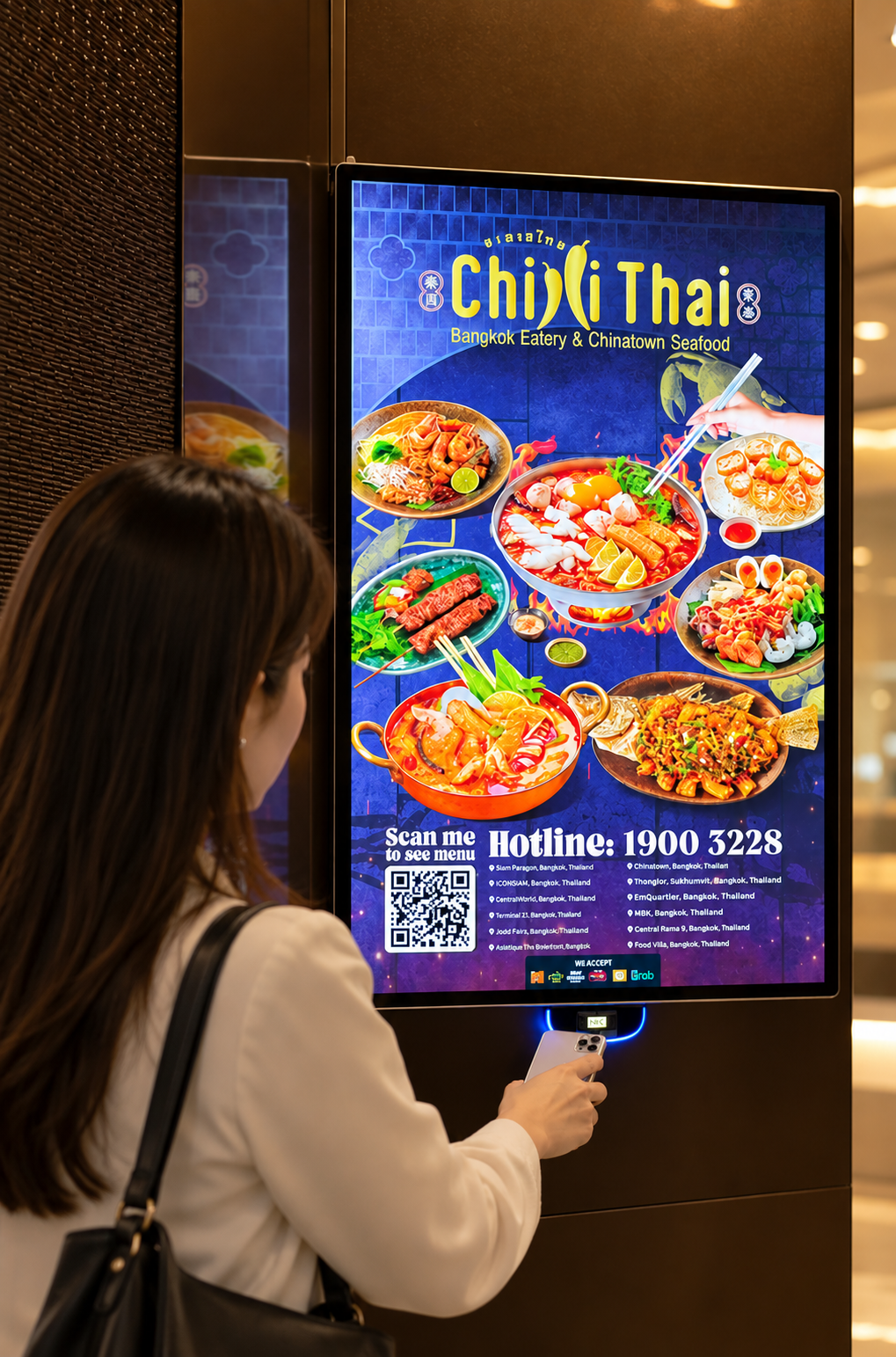
According to a 2024 study by OAAA and The Harris Poll in the US, among those exposed to location-based digital advertising, 47% searched for information about the advertiser, 41% visited the advertiser's website, and 33% accessed the advertiser's social media accounts. Businesses can leverage this behavior to develop O2O journeys from advertising screens to landing pages via NFC or QR codes.
See also: Types of Elevator Advertising: Comparison & How to Choose
5. Which industries benefit most from elevator advertising?
Not all categories are equally suitable for this channel. The industries that generate the highest ROI of brand awareness when investing in elevator advertising include:
- Real estate and finance: Long decision-making cycles, crucial brand trust, high-income target customer group living and working in high-rise buildings - elevator advertising places the brand right in front of the decision-makers in their daily living environment.
- High-end FMCG and F&B: High repeat purchase frequency directly translates brand recall into revenue. A milk, coffee, or nutritional supplement brand seen daily in elevators will have a significant advantage at the point of sale compared to competitors who only have a digital presence.
- Education, healthcare, and professional services: These industries require a high level of trust before a decision is made. A constant presence in the customer's living environment builds a sense of familiarity – a crucial psychological factor when consumers need to choose a reliable entity to entrust their health or their children's education to.
- New brand launch: The early stages of a brand's lifecycle are when brand awareness is most crucial and also most difficult to achieve. Elevator advertising creates high exposure in a short period of time – ideal for imprinting the brand name in the minds of the target customer group right from the start.

See also: Which industries are elevator advertising suitable for?
6. Effective ways to increase brand awareness
To enhance brand awareness, businesses need to develop a communication strategy based on the specific goals of each stage of development.
| Strategy | Implementation method |
| Identify your target customers. | Analyzing information needs, behaviors, and consumption habits. |
| Building a consistent brand identity | Maintain the brand name, logo, colors, and distinctive messaging across all channels. |
| Develop valuable content. | Focus on addressing the needs and problems that concern customers. |
| Coordinate communication channels | Combine social media, SEO, PR, OOH, and DOOH according to the customer journey. |
| Maintain the appropriate frequency. | Balance campaign coverage, frequency, and deployment time. |
| Measurement and Optimization | Monitor customer awareness, recall, and response levels. |
For new brands, the primary goal is to help customers recognize the name and product. For established brands, the strategy should focus on memorability in purchasing situations and maintaining a competitive advantage.
7. How to Measure Brand Awareness
According to Kantar, businesses can assess brand awareness through the ability to recognize the brand when prompted, the ability to recall it automatically, and the ability to think of the brand in specific purchasing situations.
7.1. Brand Awareness Measurement Metrics
| Index | Meaning |
| Aided Awareness | Brand awareness rate when suggested |
| Unaided Awareness | The percentage of brand recalls without prompting. |
| Top of Mind | The percentage of first-mentioned brands in the industry. |
| Brand awareness lift | Increased brand awareness |
| Reach | Advertising audience size |
| frequency | Average frequency of exposure |
| Branded Search | Brand-related search volume |
Aided Awareness, Unaided Awareness, and Top of Mind directly reflect the level of brand awareness. Reach, Frequency, and Branded Search are supporting metrics for evaluating communication effectiveness.
See also: Measuring DOOH Advertising: Metrics and Evaluation Methods
7.2. Formula for calculating Brand Awareness
For surveys without weighting, brand awareness is calculated as follows:
Brand Awareness (%) = (Number of people aware of the brand / Total number of valid survey participants) × 100
For example, in a hypothetical survey of 500 target customers, 350 people recognize the brand when presented with its name. In this case, the Aided Awareness rate is 70%.
To evaluate the effectiveness of a campaign, businesses can conduct surveys before and after implementation. If they want to determine the specific impact of the advertisement, a study with an appropriate control group needs to be designed.

8. Frequently Asked Questions about Brand Awareness
8.1. How do Brand Awareness and Brand Identity differ?
Brand awareness reflects the extent to which customers recognize and remember a brand, while brand identity is the system of identity built by the business, including its name, logo, colors, and design style.
8.2. How do Brand Awareness and Brand Equity differ?
Brand awareness refers to the level of brand recognition. Brand equity is the added value that a brand brings to a product or service. Brand awareness is one of the factors that contribute to the formation of brand equity.
8.3. What is a good Brand Awareness score?
There is no standard level of Brand Awareness for all businesses. This metric needs to be assessed based on the industry, initial awareness level, target customer group, and comparison with competitors.
8.4. How long does it take to build brand awareness?
The time it takes to build brand awareness depends on the budget, market scope, content quality, and frequency of communication. Businesses should conduct regular surveys to assess changes.
Building brand awareness is the process of helping a brand become recognizable, memorable, and considered by customers when purchasing needs arise. With over 19,000 screens in more than 2,000 locations as of October 2026, Focus Media Vietnam provides elevator communication solutions tailored to each customer group and brand development goal. Contact Focus Media Vietnam for advice on implementation options that fit your company's budget.
See also: Elevator Advertising Price List 2026: LCD & Digital Frame


Comment (0)
Related News






 CONTACT
CONNECT WITH FOCUS MEDIA VIETNAM
Share your campaign goals. Focus Media Vietnam will advise on how your brand can appear at the right touchpoints within the building and connect viewers to your landing page, e-commerce platform, app, or digital content.

No comments yet. Be the first to share your thoughts.