
 Tiếng Việt
 English
 中文
Are elevator advertisements effective? Review & Analysis
Last updated: 07 Nov 2026With the rapid increase in high-rise real estate projects, one of the recurring questions for marketers and brand managers when planning an IMC plan is: "Is elevator advertising effective?" or more specifically, "Is elevator advertising effective in apartment buildings and offices in Vietnam?".
To answer practically: The core effectiveness of elevator advertising lies in its ability to build brand awareness and engrave it in consumers' memories through repetition .
Many businesses often expect every communication channel to generate sales immediately. However, in reality, each touchpoint plays a different role. While social media is the optimal place for conversions, elevators are the ideal space to sustainably cultivate brand awareness. This article will help you clarify the line between what elevator advertising can and cannot measure, and some of the characteristics that make this network truly powerful.
1. Four "golden" characteristics of elevator communication networks
Why has a space of less than 3 square meters become a "golden opportunity" for brand campaigns? The answer lies in four irreplaceable characteristics of elevator advertising :
- Captive audience : In a confined space, elevator users tend to seek a focal point to avoid awkward communication. A brightly lit advertising screen with just the right amount of sound naturally attracts attention and creates a subtle sense of "compulsion."
- High frequency : The upward and downward movement occurs regularly every day, making the advertising message a part of daily life, automatically imprinted in the viewer's memory (top of mind) through repetition.
- Location-based targeting allows brands to segment their customer base with high precision. You can choose to target apartment buildings to reach entire families or focus on Class A and B office buildings to reach high-purchasing office workers.
- Low-distraction environment : Unlike the social media environment, which is cluttered with thousands of pieces of content, the elevator is a moment when consumers are informationally unfocused. Therefore, the likelihood of viewing an advertisement completely is very high.
2. Real-world data: Elevator behavior of Vietnamese people
From a data perspective, NielsenIQ (NIQ)1's survey on the commuting habits of Vietnamese urban residents shows high traffic volume:
- In apartment buildings: Residents use the elevator an average of 5.9 times per day.
- At the office building: Staff use the facilities an average of 5.5 times per day.
The waiting time in the lobby and the time spent inside the elevator cabin typically lasts from a few tens of seconds to over a minute. This is the "golden time" for a TV commercial to play its entire loop, reaching the target audience without creating a feeling of annoyance or causing them to "skip" the advertisement.
3. Measurement boundaries of elevator advertising
Given the short travel time between floors and the tendency for cabins to become crowded, requiring customers to perform a complex series of actions (taking out their phone, opening the camera, adjusting the angle to scan the QR code, waiting for the page to load, and then filling out the form) to finalize an order on the spot is a major obstacle.
Instead, the true power of elevator advertising lies in the following metrics:
- Traffic and frequency: The digital system allows marketers to transparently verify the actual number of ad plays and estimate traffic reach in each building.
- Increased brand awareness (brand lift): Unlike quick glances on social media, the enclosed, less distracting space of an elevator creates a superior ad recall rate. Marketers can verify this through real-world metrics such as awareness, consideration, and purchase intent in periodic measurement reports.
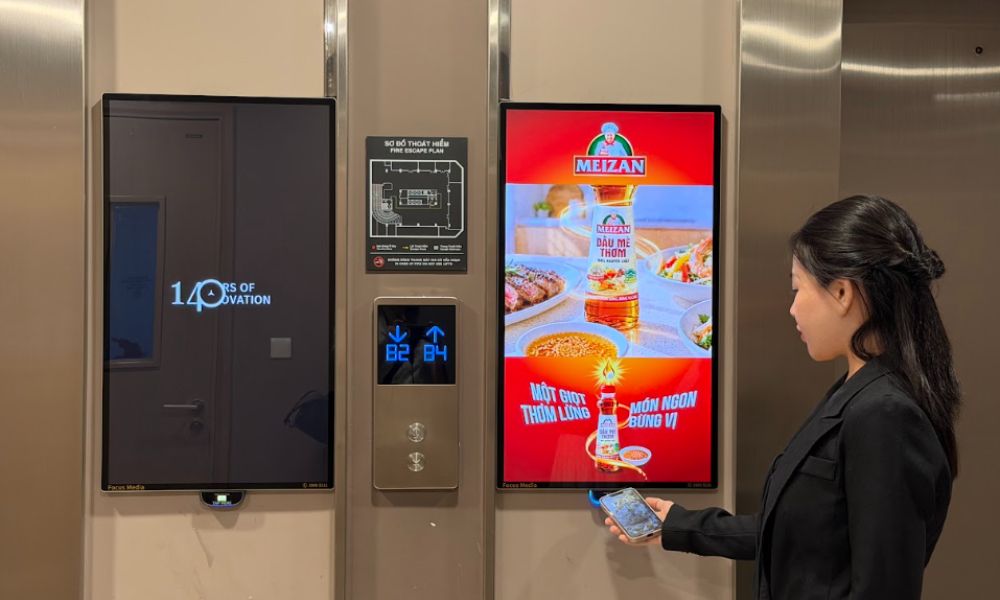
- Intelligent physical interaction: Currently, the next-generation communication solution of Focus Media has integrated NFC touch technology under the screen. Customers simply "tap" their phone to connect directly with the Focus Media Mini App to receive vouchers or product samples. This is key for businesses to collect data, measure conversion rates from offline to online (O2O), and open up retargeting opportunities even after customers have left the elevator.
4. Measuring effectiveness: Real-world data verification
To answer the question "Does elevator advertising really work?", the following independent measurement reports from NIQ will show how this media channel transforms repetition into concrete growth metrics:
- Want Want Frozen : Starting as a completely unfamiliar brand to 72% of consumers, a high-frequency advertising campaign over 8 weeks helped Want Want achieve an 81% advertising awareness rate. Of those viewers, 79% correctly identified the brand name, and 78% indicated an intention to purchase the product.
- Nanfu Alkaline Batteries : Although dry batteries are a product that customers are less likely to actively seek out, the consistent frequency of their advertisements helped Nanfu achieve an ad recall rate of 73% (higher than the market benchmark of 55%). Notably, 86% of viewers correctly identified the brand, and 83% developed a purchase intention.
As can be seen, even without generating immediate sales closings in the cabin, the purchase intent indicators of 78-83% demonstrate that this communication channel does a very good job of "stimulating demand" to drive sustainable purchasing behavior afterward.
5. Comparison of characteristics: Traditional OOH advertising and elevator advertising
Elevator screens are not designed to replace traditional formats like signs or billboards. In fact, each channel focuses on a specific touchpoint and leverages its unique strengths:
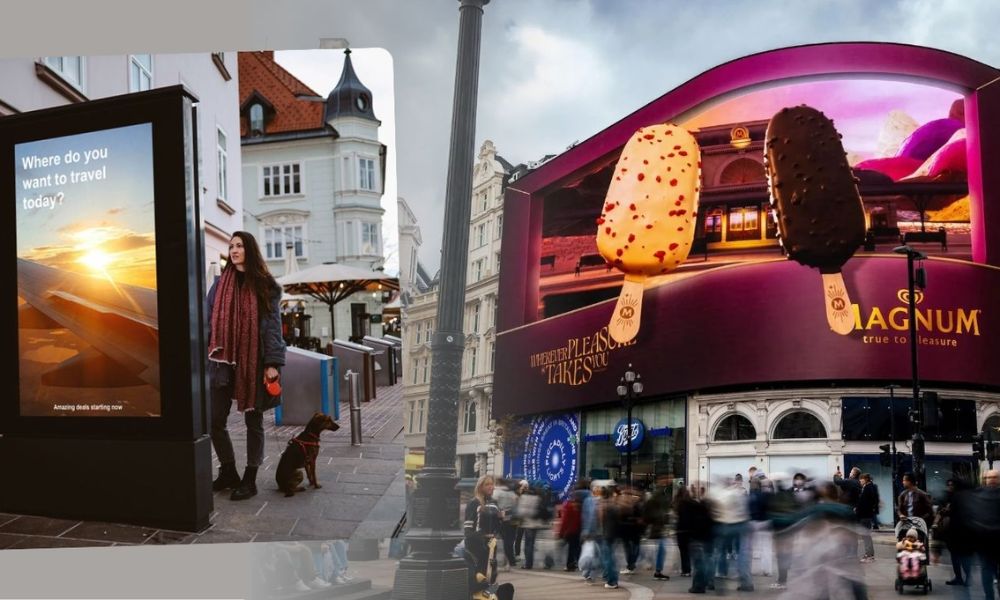
- Traditional OOH (Out-of-Home) signage: The core strength is its large display area and ability to reach a large number of passersby (mass audience). However, with typical on-the-road exposure times ranging from 3-5 seconds, this channel is best suited for displaying key visuals and concise messages.
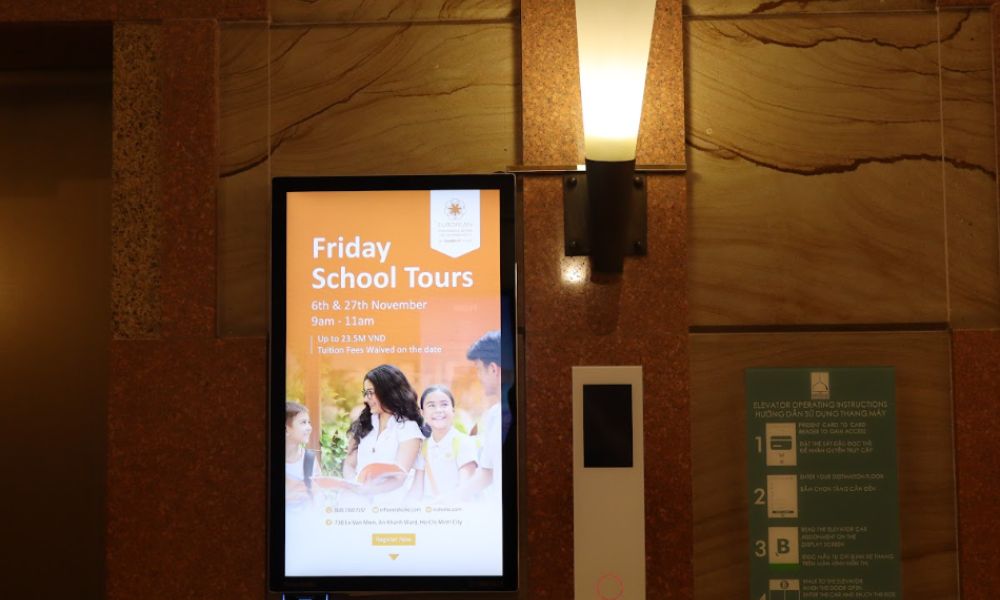
- Elevator advertising: Despite its limited space, this channel has the advantage of close proximity (at eye level). With longer viewing times and fewer distractions, it's a suitable environment for brands to convey more detailed messages and reach customers who live and work in high-rise buildings on a daily basis.
Conclude
In summary, the core value of elevator advertising lies in its ability to provide constant reminders in a low-distraction environment. Leveraging this communication channel as a brand reinforcement solution, rather than a quick "sales closing" tool, will help campaigns generate positive changes in brand health. This is how products can gradually and sustainably enter the minds of urban consumers.
To learn more about the implementation process and how the campaign will operate, please contact Focus Media for consultation and pricing.
1. Source: Report “Measuring the effectiveness of advertising in office buildings and apartment complexes for the Nanfu alkaline battery brand”, NielsenIQ (NIQ) for Focus Media Vietnam, 2026.


Comment (0)
Related News



 Contact
Let Focus Media Vietnam
Bring your brand into urban life
Share your campaign objectives. Focus Media Vietnam will advise on how your brand can appear at relevant touchpoints within the building and connect viewers to landing pages, e-commerce platforms, apps, or digital content.

No comments yet. Be the first to share your thoughts.