
 Tiếng Việt
 English
 中文
Data & Research
Elevator advertising effectiveness: 95.9% encountered within a week, 70.7% noticed.
Last updated: 26 Nov 2026Are elevator advertisements frequently encountered and noticed by consumers? According to the Focus Media DDP Study – Vietnam Tracker, 95.9% of survey participants reported encountering elevator advertisements in the past week, 70.7% paid attention to most of the ads, and 61.75% were willing to interact via QR/NFC. These results provide insight into consumer advertising reception behavior, giving businesses a basis for building multi-channel communication strategies.
1. Research Overview
Focus Media DDP Study – Vietnam Tracker is a study examining consumer exposure to and responses to advertising in Vietnam, with the participation of Kantar. The survey used a hybrid fieldwork approach, comprising 200 online and 200 in-person respondents, for a total sample of 400 respondents.
This study compares elevator advertising with television, Internet TV, long-form video platforms, short-form video, social media, and outdoor billboards/LED screens. Key metrics include reach, attention, ad completion, ad recall, and QR/NFC engagement readiness.
Note: Reports use online, offline, or combined templates depending on the metrics. Therefore, not all results are assumed to have the same sample size. This article prioritizes actual data; weighted/final metrics are included separately when necessary.
2. Reach: 95.9% encountered elevator advertisements during the week.
Among the media types surveyed, elevator advertising recorded a notable exposure rate. Specifically, 75.3% of participants reported encountering elevator advertisements the previous day. When extending the time period to the previous day or within a week, this rate increased to 95.9%.
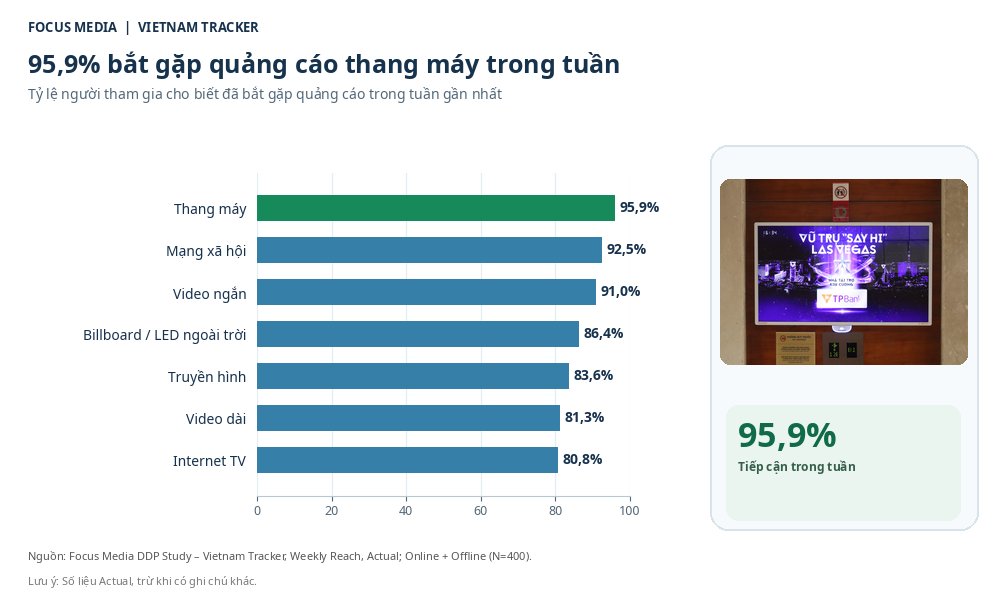
Comparisons with other media channels show that elevator advertising has a higher exposure rate than social media, short videos, and outdoor advertising in the survey sample. Specifically:
| Advertising channel | On the previous day | In the most recent week |
| Elevator advertising | 75.3% | 95.9% |
| Social network | 72.0% | 92.5% |
| Short video | 66.1% | 91.0% |
| Outdoor billboard/LED screen | 52.8% | 86.4% |
| Traditional television | 51.1% | 83.6% |
| Long video platform | 49.3% | 81.3% |
| Internet TV | 43.0% | 80.8% |
Source: Focus Media DDP Study – Vietnam Tracker, Daily Reach and Weekly Reach, Actual; Online + Offline (N=400).
Notably, the rate of encountering elevator advertisements remained high across both survey periods. This suggests that this advertising channel has the potential to create opportunities for consumer interaction within their daily routines, in addition to familiar touchpoints on digital platforms.
For businesses, this result highlights the role of elevator advertising in a multi-channel communication strategy, especially when brands need to expand their touchpoints in where consumers live, work, and commute. However, the encounter rate in the survey does not equate to the number of impressions or the unique reach of an actual campaign.
See also: Elevator Advertising or Online Advertising: Which is the Optimal Choice?
3. Level of attention: 70.7% paid attention to most of the advertisements.
Not only did elevator advertising record a high exposure rate, but it also demonstrated a remarkable ability to attract attention in the study. Specifically, 70.7% of participants reported paying attention to most elevator advertisements they encountered. This was the highest percentage among the media types surveyed.
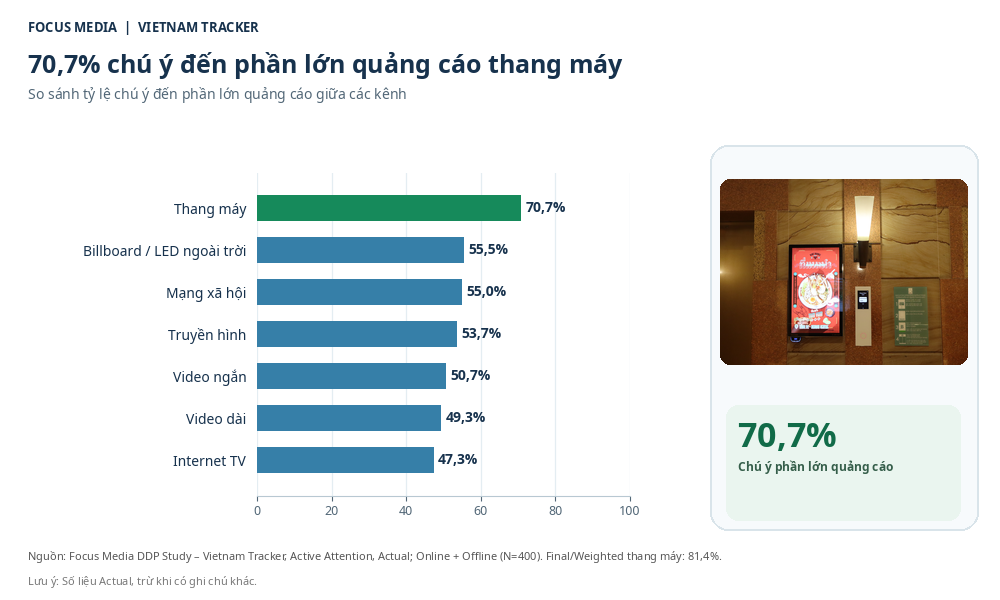
| Advertising channel | Pay attention to most advertisements. |
| Elevator advertising | 70.7% |
| Outdoor billboard/LED screen | 55.5% |
| Social network | 55.0% |
| Traditional television | 53.7% |
| Short video | 50.7% |
| Long video platform | 49.3% |
| Internet TV | 47.3% |
Source: Focus Media DDP Study – Vietnam Tracker, Active Attention, Actual; Online + Offline (N=400).
Conversely, 27.1% of participants reported only paying partial attention to advertisements while doing other things; 1.4% rarely focused, and 0.7% often ignored the content. This indicates that attention levels still vary among individuals, even when exposed to the same advertising channel.
4. Viewing duration: 79.7% viewed elevator ads for 6-15 seconds.
Viewing duration is an indicator reflecting the amount of time consumers are exposed to an advertising message. According to the Focus Media DDP Study – Vietnam Tracker, 79.7% of participants in the group viewed elevator advertisements for 6-15 seconds , higher than other media channels in the survey.
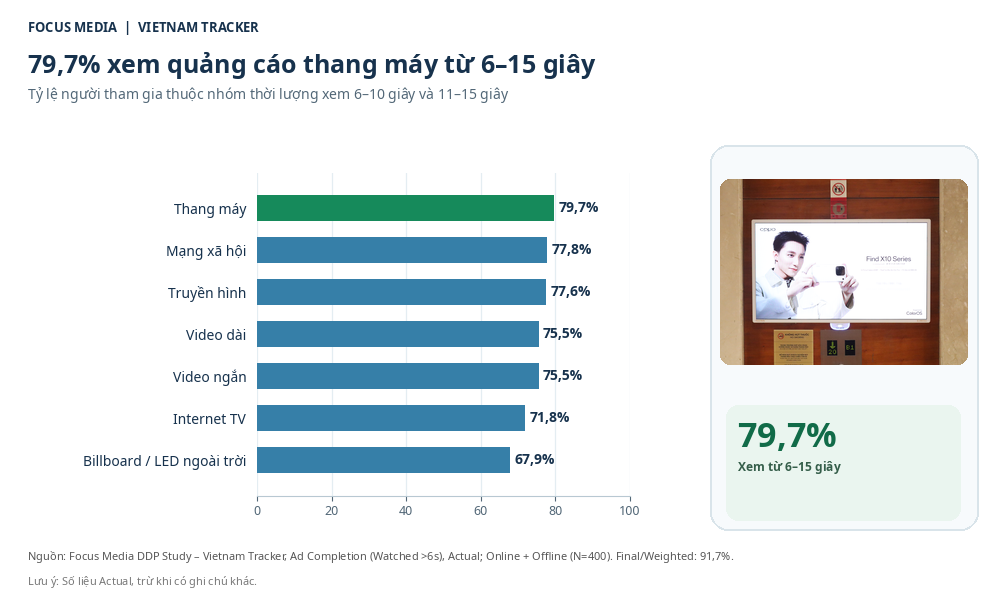
| Advertising channel | Viewing rate from 6 seconds |
| Elevator advertising | 79.7% |
| Social network | 77.8% |
| Traditional television | 77.6% |
| Long video platform | 75.5% |
| Short video | 75.5% |
| Internet TV | 71.8% |
| Outdoor billboard/LED screen | 67.9% |
Source: Focus Media DDP Study – Vietnam Tracker, Ad Completion, Actual (N=400).
After adjusting for reach and attention quality, elevator advertising achieved a 91.7% (Final/Weighted) rating. The results show that elevator advertising has an advantage in terms of exposure time within the surveyed channel group, while also highlighting the importance of concise content, clear visuals, and memorable messages.
5. Memory retention: On average, 4.3 elevator advertisements
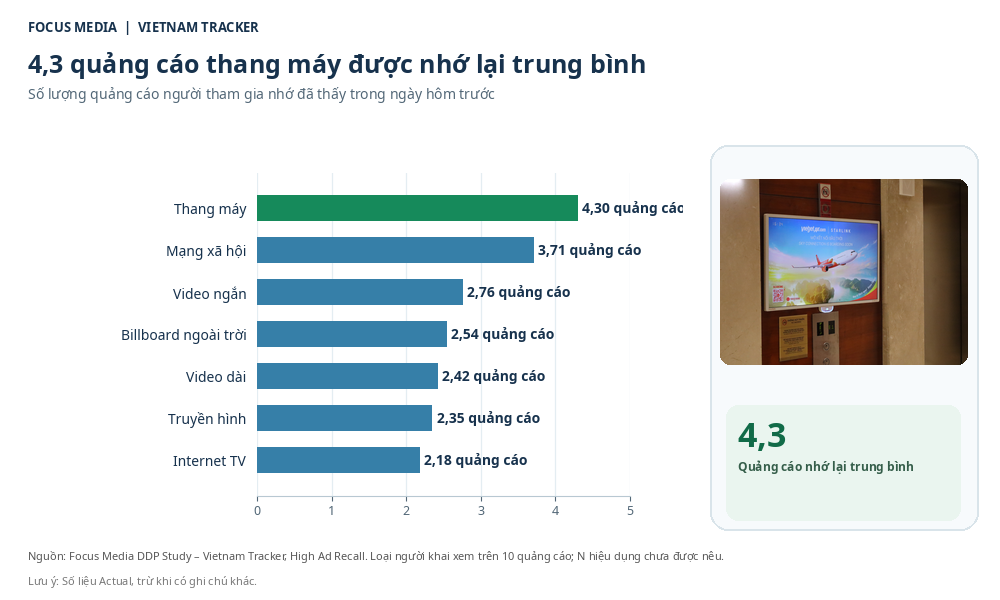
Memory retention is a crucial aspect when assessing advertising reception. According to the Focus Media DDP Study – Vietnam Tracker, survey participants remembered an average of 4.3 elevator advertisements they had seen the previous day, higher than other media channels.
| Advertising channel | Average number of ads remembered |
| Elevator advertising | 4.30 |
| Social network | 3.71 |
| Short video | 2.76 |
| Outdoor Billboard | 2.54 |
| Long video platform | 2.42 |
| Traditional television | 2.35 |
| Internet TV | 2.18 |
Source: Focus Media DDP Study – Vietnam Tracker, High Ad Recall, Online + Offline.
Notably, the calculation excluded those who reported seeing more than 10 ads, but the report does not specify the remaining sample size. The 4.3 figure reflects the average number of ads recalled, not the brand recall rate.
See more:
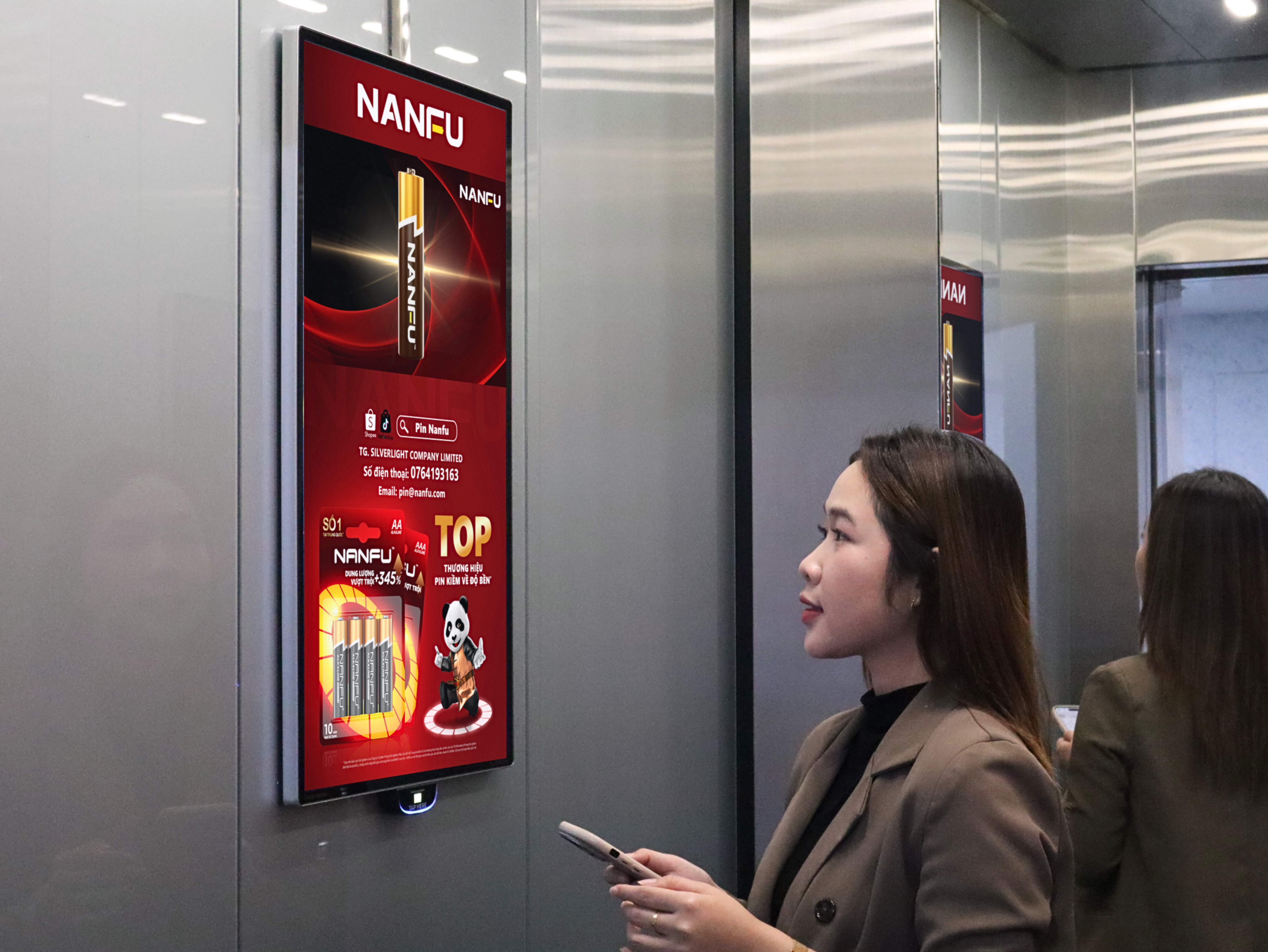
- What does the elevator advertisement help viewers remember about Nanfu alkaline batteries?
- Want Want Frozen: 78% of those surveyed intend to buy after 8 weeks of elevator advertising.
6. Intention to interact: 61.75% are willing to use QR/NFC.
Elevator advertising not only creates opportunities for exposure to the message but can also lead to further action. Surveys show that 61.75% of participants are willing to touch or scan QR/NFC on elevator ads to receive more information, nearly equivalent to social media (61.5%).
The topics participants want to learn about during the interaction include:
| Content of interest | Selection rate |
| New product information | 75.0% |
| Discounts and promotions | 63.5% |
| Useful service announcements | 55.25% |
| Upcoming event or activity | 51.5% |
| Information about the brand you want to learn more about. | 37.0% |
Source: Focus Media DDP Study – Vietnam Tracker, Willingness to Interact and Content Interested to Interact with NFC/QR; Online + Offline (N=400), Actual.
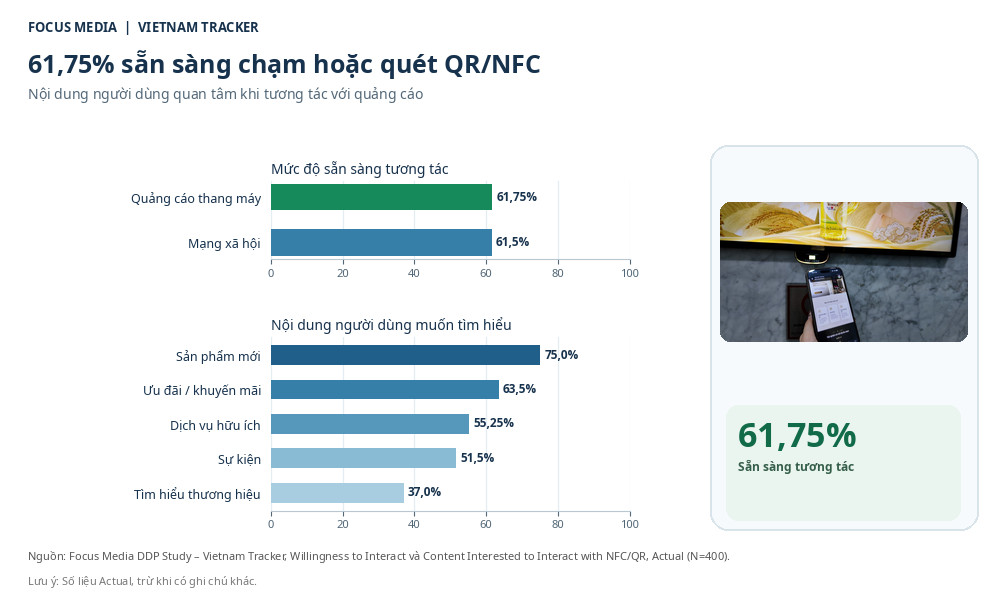
New product information was the most popular topic (75%), followed by offers and promotions (63.5%). This forms the basis for businesses to design O2O journeys from screen to landing page that meet viewer needs. The readiness rate in the survey is not the actual scan, touch, or conversion rate.
See also: Focus Media Vietnam Launches MiniApp, Expanding Engagement Through Elevator Advertising
7. At shopping malls, 70.8% pay attention to most elevator advertisements.
In shopping malls and supermarkets, elevators are a key touchpoint in the shopping journey. Among participants who visited these locations at least once a week, 91.25% reported passing by an elevator at least once during each visit.
In terms of attention, elevator advertising achieved 70.8%, higher than other advertising locations in the survey.
| Advertising location | Pay attention to most advertisements. |
| Elevator advertising | 70.8% |
| Billboard | 65.7% |
| Large LED screen | 65.3% |
| Screen near the checkout counter | 62.1% |
Source: Focus Media DDP Study – Vietnam Tracker, Active Attention – Mall, Actual (N=400).
In terms of advertising recall, the offline survey group (N=200) remembered an average of 4.08 elevator ads, compared to 3.70 ads on large LED screens, 3.55 on screens near checkout counters, and 3.35 on billboards.
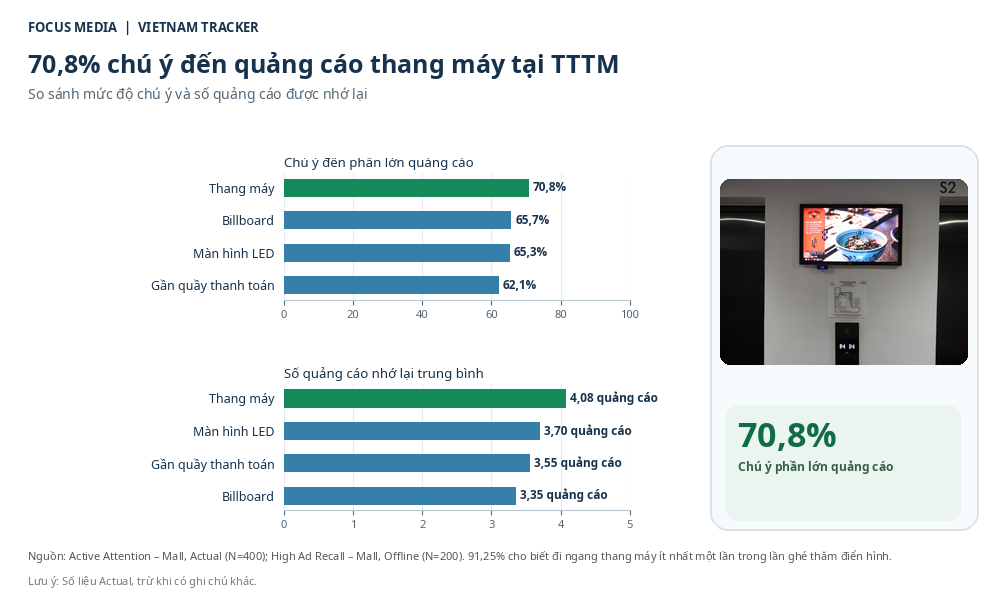
Source: Focus Media DDP Study – Vietnam Tracker, High Ad Recall – Mall, Offline (N=200).
The results show that elevator advertising is a worthwhile touchpoint to consider in shopping spaces. However, businesses still need to select locations based on traffic, customer characteristics, and specific screen placement.
8. How can businesses utilize data?
Research findings suggest that elevator advertising can play a complementary role in a multi-channel communication strategy, especially when businesses want to expand touchpoints and increase opportunities for customer interaction.
When implementing, businesses should focus on three factors:
- Location selection: Prioritize buildings, living areas, workplaces, or shopping locations that align with the target customer profile.
- Content optimization: Choose between LCD or Digital Frame based on location and communication goals; prioritize concise messaging, clear images, and consistent brand identity.
- Interactive integration: Combine QR/NFC with product pages, offers, or registration forms; track scans and actions on the landing page to gauge real-world response.
At Focus Media Vietnam, research data serves as a reference when advising on placement, format, and content tailored to each brand's objectives. Specific plans should incorporate customer data, location lists, timing, frequency, and DOOH advertising metrics that align with campaign goals.
The survey results show that 95.9% of participants encountered elevator advertisements during the week, 70.7% paid attention to most of the ads, and 79.7% viewed them for 6–15 seconds. This data is for reference when choosing communication channels and does not guarantee the effectiveness of any campaign.
Businesses can combine Focus Media's elevator advertising solution with the NFC Mini App to connect advertising screens with actions in the digital environment. Contact Focus Media today for a consultation.


Comment (0)
Related News



 CONTACT
CONNECT WITH FOCUS MEDIA VIETNAM
Share your campaign goals. Focus Media Vietnam will advise on how your brand can appear at the right touchpoints within the building and connect viewers to your landing page, e-commerce platform, app, or digital content.

No comments yet. Be the first to share your thoughts.